Showing posts with label self-care. Show all posts

Jan 4, 2017

Tai Chi – The Best DVD Lessons


I became interested in Tai Chi, one of the best known martial arts from ancient China (more information and history). I’ve been receiving acupuncture, and I wanted to try something myself to nurture my internal energy, qi, to enhance my wellness.  I don’t want you to think Tai Chi is a mere workout or exercise; it is an art. 

I came across Dr. Paul Lam’s Tai Chi for Health series on YouTube.  I watched the free first lessons, and I was very impressed with the slow pace, thorough instructions of every step, and helpful explanation of Tai Chi philosophy.  The slow pace and detailed instruction are must for me. I often get frustrated with yoga classes both in person and videos because the pace is too fast, and the instruction isn’t always clear. Dr. Lam’s calm and kind voice alone makes you peaceful and happy. You feel like he is really there in front of you to guide you through. 

I bought Tai Chi for Energy (outside USA), and I am in the middle of the 8-lesson course.  In each lesson, you will learn only a segment of the complete sequence of movements (3 minutes in total).  Each lesson goes over the previous learned forms, and the sequence gets longer.  I practice each lesson for 3-4 days before moving on to the next lesson because I’m so looking forward to the next lesson although my movement isn’t smooth yet. The reason I said Tai Chi is an art is the first movement you learn is to put the foot apart.  You have to put your mind to every single movement, however simple and subtle it is.  Tai Chi trains your mind to slow down and concentrate.  It takes time and many practices to “master” seemingly easy flow of slow movements.  It can be very difficult for some people to slow down, but once you let yourself go and follow the flow, it will be very calming as well as revitalizing. 

This page shows you what DVDs you can start with.  Tai Chi is proven beneficial especially for people with arthritis, and Dr. Lam’s Tai Chi for Arthritis is endorsed by Arthritis Foundations and CDC.  There are many other DVDs such as Tai Chi for Diabetes, Tai Chi for Rehabilitation, and Tai Chi for Osteoporosis. 


I am not getting compensation for promoting the products.  I simply believe that they are the best DVDs to learn Tai Chi.

Dec 24, 2016

Do You Have Migraines? Have You Tried This Method?

Headaches and migraines are the most common, yet very distressing condition that many people get.  I’ve written many posts about headache relief.  Recently, I gained better insight into migraines from webinars and articles by Til Luchau, LMT.  

Migraines were thought to be caused by dilated blood vessels of the brain.  However, it is now being viewed as a nervous system disorder, along with other factors.  A goal of massage or bodywork is to reduce the compression on the cranial nerves. 

One of the ways you can try to relieve migraine pain is pulling your ears.  When you pull your ears, you also pull the temporal bones slightly. Deep behind the temporal bone is the trigeminal nerve, the likely cause of migraines and cluster headaches.  Pulling the ears might help relieve the pressure on the trigeminal nerve.  You should experiment which angle of the pull relieves the pain better; straight to the side, up, down, back and etc.  Once you found the right angle, hold the traction and relax for a while. I hope this will work for you.


If you are interested in finding more details and other ways to relieve migraine pain, read the article here.  It is designed for massage therapists/bodyworkers, but you can try yourself or ask your massage therapist if they are familiar with the techniques.

Jul 9, 2016

Calm Your Anxiety with Breathing Exercises


When we have stress, anxiety, and worries, we don’t breathe normally.  Shallow breathing could cause a panic attack for some people.  Keeping breathing under control not only calms our anxiety, but also transforms our life.    

There are many breathing exercises available.  I came across the book called Healing Power of the Breath.  It explains various breathing techniques and their benefits in different conditions or situations from trauma to relationships.  It emphasizes that breath is a “portal to the mind-body system.”  
Messages from the respiratory system have rapid, powerful effects on major brain centers involved in thought, emotion, and behavior. 
The exercises are very simple.  I found it more helpful to listen to the audio and follow the guiding cues to do the exercises.  

I will introduce 3 basic techniques.

1. Coherent Breathing
A rate of 5 breaths per minute- 5 bpm (inhaling for 6 seconds and exhaling for 6 seconds). 
Purpose: To increase Heart Rate Variability (HRV) by changing the pattern of breathing.  The higher HRV, the more flexible cardiovascular system and more resilient stress-response system.

If you were to learn one breathing technique, choose Coherent Breathing.  It helps relieve stress, tension, anxiety, worry, phobias, insomnia, and respiratory problems. 

  • Sit or lie down in a comfortable position. 
  • Close your eyes and mouth, and breathe through your nose. 
  • Breathing should be very slow, gentle and comfortable, not forced.
  • Play the practice. (If 5 bpm is too slow, play the beginning of this practice at 6 bpm.)


2. Resistance Breathing
Any kind of breathing that creates resistance to the flow of air (by pursing the lips, hissing, tightening the throat and etc.)

Purpose: To stimulate the parasympathetic nervous system by the increased pressure in the lungs, inducing relaxation. (Like cats purr!)


3. Breath Moving
With imagination, moving breath and awareness to different parts of the body
Purpose: To improve the circulation of energy through the nervous system and improve blood flow. (In Easter traditions, to open chakras and dissolve blockages so energy can circulate more freely.)

I personally like Breath Moving because I am a visual person.  When I am lying down, I can easily picture the breath as waves coming in and going out.


Total Breath
The combination of Coherent Breathing, Resistance Breathing, and Breath Moving.
Purpose: To maximize effectiveness and rapidity of response.
The book recommends you practice once a day for at least 20 minutes with full concentration. 
 
Body Scan
After breathing practices, finish with Body Scan to allow your system to consolidate the effects.  You can choose any other form of relaxation (meditation, visualization, deep prayer, and etc.).  It helped me calm down better because following the practices makes me more alert than relaxing.   

If you would like to know other healing breath practices including vibration breathing, and also make these great breathing practices your routine, download the audio files here to your device.  The book has much more information, and includes a helpful chart “How and When to Use Each Practice” in the appendix.

Hope these breathing practices transform your life!
            
These audio files are for your own personal use only.

May 4, 2016

Shinrin-yoku – Forest Bathing

   © Naoko Otani

Shinrin-yoku (森林浴): A visit to a forest for relaxation and healing

I was lucky to have grown up close to nature for the Japanese, who live in a crowded city.  My parents frequently took me to the mountains, rivers and lakes.  I loved the sound of rivers and sweet smell of earthy air in the forest and mountains.  I feel at home when I’m in the woods because that’s where I can totally relax, get energized, and, above all, feel being part of the universe. 

I often heard of the term, shinrin-yoku, in Japan, so I was surprised to come across this Japanese word in English articles recently.  It’s no surprising that being in nature makes us feel better and relaxed.  However, the recent studies show scientific evidence that being exposed to the forest air has positive physiological effects.  In Japan, as of now, there are 64 accredited areas and trails for shinrin-yoku therapy.

Major effects noted in the studies are:
  • Boosted immune system: increased natural killer (NK) cell activity, the number of NK cells, and levels of anti-cancer proteins
  • Reduced stress: lowered cortisol (stress hormone) and pulse rate
  • Lowered blood pressure
  • Greater parasympathetic nerve activity  

The effects in the studies are often associated with phytoncides, aromatic volatile organic compounds released from trees and plants.  However, forest environments affect us through all of our senses: sight of scenery, smell of wood and flowers, sound of running streams, chirping birds, or the rustle of leaves, feel of grass and trees, and for some people, taste of edible plants.   

Let’s head out for the forests and relax! 

No time right now?  Watching a 5-minute Forest Therapy Break made by Association of Nature and Forest Therapy Guides and Programs might help you relax.


Nov 27, 2015

10 Tips to Choose the Right Shoes

Buying a good pair of running or walking shoes is a must for everybody if you want to save yourself from pain or injuries.  A pair of running shoes is said to last for 400-500 miles.  A good pair costs about $100-$150, which isn’t inexpensive, but it is a good investment.  If you consider medical expenses incurred from pain or an injury by a wrong pair of shoes, it isn’t bad at all.  It will also be a great holiday gift for anyone you care.

I don’t recommend you pick a pair by yourself just because they feel comfortable.  Find the right specialty running shoe store (recommended stores).  It is kind of choosing a bra (for women).  Even if you think you know your size because you think it always fits you, a trained salesperson might tell you otherwise (it happened to me).  Good shoe stores have salespeople who are runners and know exactly how to pick the right shoes for you. 

I recently went shopping for a new pair of running shoes, and I had a great experience.  I always pick a locally owned shoe store highly rated by runners.  This time, I found one from Jeff Galloway’s website because there isn’t a good one around in my area.  I ended up spending more than an hour to finally decide on one, which was the first pair I tried.  I didn’t have any preference for brands, colors, or styles, so a salesperson brought 5-6 pairs from different brands after she checked the soles of my old pair I brought, and how I walk, to make sure of my feet type (mine is neutral).  They let me run outside the store to test each pair that gave me a good first impression.  I appreciated my salesperson’s knowledge and patience, which made me sure that the pair I picked was the RIGHT ONE.     

Here are my 10 TIPS for running shoe shopping.  You can find more useful information at Jeff Galloway’s website, REI and Runner’s World.
  1. Make sure a salesperson measures your feet, checks how you walk (feet type), and asks about your running activity.
  2. Spend at least half an hour or more to pick a pair, preferably at the end of the day.
  3. Be open to any brands, colors, styles and even a size, so you can have more choices.
  4. Do not pick the exact model that you had in the previous year or before without trying them on.  A new model always changes, for better or worse.
  5. If anything about fit bothers you, don’t buy the pair.  It will only bother you more later, never less.
  6. Try a few more pairs even if the first pair feels perfect.  You never know if there is a better pair. 
  7. Buy special running socks at the store (you don’t find those in regular stores).  They never chafe your feet and make a big difference.
  8. If you still like the model after using it for a while, buy another pair before a new model comes out, especially if you run regularly and need another pair within a year.
  9. Learn the best way to tie shoe laces.
  10. Ask about their exchange policy. 

Nov 20, 2015

Herbal Teas for Headaches (2) - Let’s Make Tea!

Making tea from bulk herbs is easier than you think.  Above all, it tastes much better!

HERBS
I would highly recommend you buy dried BULK herbs at a health food store with a bulk section, especially ORGANIC ones (unless you have fresh herbs in your garden).  First, you know what you are getting because I’m not really sure about the quality of herbs in tea bags.  You must have experienced that tea made from loose leaf tastes and smells much better than one from a tea bag.  I tried green tea bags from different brands, but it doesn’t taste anything like real green tea, so I am always wondering if manufactures use low grade tea leaves or herbs for tea bags.

Buying herbs in bulk also gives you many advantages.  You can find more varieties of herbs, and buy only the amount you want.  You can also pick the specific herbs most beneficial for your condition and blend them exactly the way you like.  Lastly, it definitely saves you a lot.

EQUIPMENT
You can find all kinds of tea pots and cups with an infuser in stores.  If you don’t have any of these, you can use a mug and strain the herbs with a strainer later.  I use a French coffee press for making more than one cup, but I usually use one very similar to this in the picture below from Zen Formosa (I don’t remember the brand of mine, since it’s been years since I bought it).  It’s even easier than making a cup of coffee.
INSTRUCTIONS
Amount
In the book “20,000 Secrets of  Tea – The Most Effective Ways to Benefit from Nature’sHealing Herbs” by Victoria Zak, a heaping tablespoon of bulk herbs is required, but I feel it’s too much. I normally use about ½ to 1 teaspoon, and it still comes out pretty strong depending on the herbs.  You might want to start with ½ teaspoon to get used to the taste.

If you use fresh herbs (softer and hard parts of a plant), cut the herbs into small pieces and use 2 tablespoons per cup.   

Steeping time
Pour boiled water to a pot or a cup, and cover.  Steep for 3-5 minutes for dried herbs, 7-10 minutes for softer parts of fresh herbs.  For hard parts of fresh herbs such as bark, twigs, seeds, roots, or rhizomes, put pieces of the herb in a pot, cover it with cold water, and bring the water to a boil.  Simmer for 1 hour.

Sugar/Sweeteners
The author of the book doesn’t encourage you to sweeten tea if you take herbal teas as healing remedies.  I agree.  I enjoy the earthy, bitter flavor of herbs, which tastes almost like medicine.  It’s psychological, but I feel like it works better that way.

Enjoy a blissful cup of tea!

Nov 13, 2015

Herbal Teas for Headaches (1) - Herbs


In the last post “Herbal Teas for Healing,” I talked about great healing benefits of herbal teas.  I’m going to introduce the herbs recommended for headaches, migraines and sinuses from the book "20,000 Secrets of  Tea – The Most Effective Ways to Benefit from Nature’s Healing Herbs” by Victoria Zak.  You will be surprised to find some of the herbs are already in your pantry!  In the next post, you will find my tips on how to make tea from bulk herbs, which I strongly recommend.
This guide is for your information only.  
Please see an herbalist if you need professional assistance.

HEADACHES/MIGRAINES

Feverfew “Manna for Migraines and Allergies” (headaches & migraines)
  • Inhibits histamine release and relax blood vessels and nerves.   
  • A liver stimulant – Liver weakness is associated with headaches.
  • Other values: Anti-inflammatory; uterine stimulant; digestive stimulant; brings on menstruation; expels worms
  • *Caution: Don’t use it if you take blood-thinning medication.
Lavender “The Herb of Harmony” (headaches & migraines)
  • Calms and steadies your nerves.
  • Other values: Analgesic; antibacterial; antiseptic; antispasmodic; carminative; nerve tonic
Milk Thistle/Silymarin “The Herb of Renewal” (headaches)
  • Strengthens your liver – Liver deficiency is linked to recurring headaches.
  • Helps to suppress the release of histamines
  • Other values: antiallergenic; antitoxin; anti-aging
Rosemary “The Gentle Revitalizer” (headaches)
  • Relaxes your nervous system
  • Other values: Antiseptic; antioxidant; expectorant; decongestant; circulatory tonic; digestive tonic; astringent; carminative; antispasmodic; antidepressant; diuretic
Ginkgo, parsley, peppermint (topical use), and wood betony also work for headaches.

SINUS CONGESTION

Feverfew: See above
Thyme “The Knockout Infection Fighter”
  • The most powerful antiseptic (antiviral, antibiotic, antifungal, antimicrobial) herb
  • Other values: Antibacterial; antispasmodic; astringent; broncho-dilator; carminative; decongestant; diaphoretic; expectorant; emmenagogue; tonic; expels worms
Bayberry, fenugreek, goldenseal, and plantain (not the banana-like plant) also work.


Nov 6, 2015

Herbal Teas for Healing


Thy food shall be thy medicine. – Hippocrates
I have been a tea drinker for a long time (drinking other than Japanese green tea), and had a collection of mostly black teas from Europe.  Over the years, I discovered red teas, white teas, and other Chinese teas as wells as herbal blended teas.  I drink tea to enjoy the subtle aroma and flavor, and the act of making tea and taking time for myself.  It’s a kind of ritual that everybody has.

My husband gave me a book called "20,000 Secrets of Tea – The Most Effective Ways to Benefit from Nature’s Healing Herbs” by Victoria Zak, which gave me new insights for herbal teas.  Chamomile tea is not the only herbal tea.  Herbs have been around for thousands of years and used medicinally.  These days, there are different forms of herbs such as in capsules, pills, and tinctures, on the market, but I like to take a natural form in a natural way (eat or drink), if possible.  I like drinking tea, so it’s a perfect way to experience the healing benefits of herbs. 

Herbal teas are the most effective way to get the benefits of herbs, safely and easily,” the book says.  If you don’t want to rely on pills for minor discomforts, and would like to strengthen your body’s own natural defenses against disease, herbal teas are for you.  The values of herbal teas are:
  • Double Benefits: Treat symptoms AND an underlying weakness.  Herbs have more than one beneficial property and value.
  • Safety: No additives, preservatives, or dyes.
  • Easy Absorption: Water – digested harmoniously in the body. 
  • Affordability: About 30 cents per cup using a tea bag.  Buying herbs in bulk will only cost you very little.
  • Universal Tradition: Used as healing remedies in every culture in the world.
The book has an A to Z list of common health issues with names of herbs best suitable for the condition.  The following chapter contains a common name, a Latin name, profiles, cautions, beneficent parts, and properties and values for each herb (more than 100) in the alphabetical order.

I look up this book most often when I get a headache, migraine, or different cold symptoms.  For a headache, I massage the neck and head, and drink an herbal tea, or both at the same time.  Herbal teas don’t ease the pain right away, but not taking pills makes me feel better and in control of my own health.  Normally, the combination of massage and a herbal tea makes the headache go away before long.   

I will introduce herbs beneficial for headaches, migraines and sinuses in the next post.

Oct 30, 2015

Training for a Half Marathon

Last November, I posted “Started Running.”  It’s my time of the year for running as the weather finally cooled down. 

I finished a 15K race in March 2015 without pain and injuries, so I set a goal a little higher for the next year – a Half Marathon.  I’ve been running for a few weeks, and I’m now going to start the training.  Like the last year, I made a training schedule referring to Jeff Galloway’s “Half Marathon Training  Please read my post “Started Running” about my experience of Jeff Galloway’s Run Walk Run method or go to his official site.

A half marathon is 13.1 mile long, and it’s about 4 miles longer than 15K (9.32 miles).  Because of my fitness level, (un)athletic background, and the warmer weather in Florida on the race day, I didn’t want to aim too high, so I decided to run a half marathon instead of a full marathon.  It is my priority to enjoy the training and complete the race without pain and injuries.

Jeff Galloway’s Half Marathon training schedule is 17-week long, but I stretched it out to 21 weeks to make the mileage increase a little more gradual.  My training pace is much slower than one for 15K, and Run Walk Run ratio is totally different from the past (he has come up with new ratios over the years).  And, if you wonder how to keep the training schedule during the upcoming holiday seasons, please read “Exercise as Part of Your Travel Plans Running in a new place during travel is now one of my favorite things to do.

Oct 23, 2015

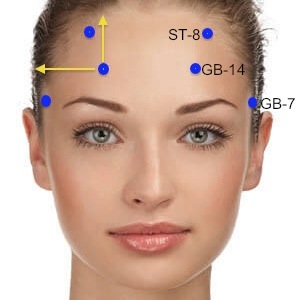
Facial Massage for Reducing Wrinkles (2) – Facial Tsubo (Acupressure Points)


What are tsubo?  They are also called acupressure points, acupuncture points, acupoints. In Oriental Medicine, there are 14 meridian systems over the entire body, and energy travels through them.  There are 365 tsubo on the human body, and they are “the locations at which it is easy for the flow of energy in the meridian systems to become sluggish and to stagnate.”  Stagnation of energy flow manifests in the tsubo in different ways such as pain, stiffness, and numbness.  When specific tsubo are treated, the flow of energy is restored, and malfunctions will dissipate.

Let’s pamper your face!  Use your favorite facial cream or serum. (Recommended products from my friend who is expert in skincare.) Do not use body lotion for the face if it has fragrance.  The facial skin, especially the eyelids, is much more sensitive than other parts of the body.  If you don’t have face cream at hand, use pure extra virgin olive oil instead.

As I explained in the last post, I referred to “Eliminating Facial Wrinkles” in the book about tsubo therapy by Katsusuke Serizawa, MD.

Around the Eyes (BL-2, TH-23, GB-1, BL-1)
Massage the upper and lower edges of the eye sockets from the inside out.
Cheeks (ST-2)
Massage in the directions of the arrows from ST-2.
Forehead (GB-14, ST-8, GB-7)
Massage and stroke with the fingertips from GB-14 toward the temples and to the hairline in the directions of the arrows.  Massage in the areas of ST-8 and GB-7. 
Around the Mouth (ST-4, CV-24)
Massage at the corners of the month ST-4, and CV-24 in the directions of the arrows.
Neck (BL-10, LI-17, CV-22)
Raise your chin as high as possible, and use four fingers to massage tsubo on the neck.  Massage in the directions of the arrows extending to the base of the neck.

I didn’t intend to introduce tsubo (acupressure) therapy as a treatment here, so I didn’t explain exactly where each tsubo is located although I indicated the numbers.  If you are curious, you can look up the locations in Atlas of Acupuncture Points (you need to know about the anatomy).

Oct 18, 2015

Facial Massage for Reducing Wrinkles (1) – Causes of Wrinkles


A facial massage is my favorite part of giving massage.  It is always enjoyed by both men and women because it is like a nice surprise.  The facial muscles can be overworked by watching, eating, talking, and making various facial expressions constantly as well as emotional tension.  When the face gets massaged, the whole body tends to relax. 

I found tsubo (acupressure points) for “Eliminating Facial Wrinkles” in the book about tsubo therapy, a type of Shiatsu, by Katsusuke Serizawa, MD.  Although I don’t believe a massage will totally “eliminate” wrinkles, facial massage will definitely promote circulation and cell turnover.

Why do wrinkles develop?  As we get older, the deeper layer of the skin (dermis) in the face diminishes and loses elastin fibers, so it gets less elastic.  And also, the skin can’t retain moisture and produce oil as much and becomes dehydrated.  It all means the skin loses strength and flexibility and tends to wrinkle and sag.  

The facial muscles are unique in the way that one end of the muscles usually attaches to the skin, instead of bone to bone like other muscles.  The facial skin is closely bound together with the tissues of the muscles.  So, the areas where muscles contract often, such as around the eyes, the forehead, and the month, tend to get wrinkled by the skin’s lack of flexibility due to aging.  Other factors for wrinkles are exposure to sun (UV light) and smoking because both speed up the natural aging process.  

Fall is here (even in Florida), and air gets drier, so it is a great idea to combine facial massage and skincare in one.  Daily moisturizing with a massage can help hydrate the skin and stimulate oil gland secretions.

Next post will show you tsubo (acupressure points) in the face for reducing wrinkles. 

Oct 5, 2015

That's Not Where It Hurts - Infraspinatus

When you get a massage, you probably have this experience: You didn’t realize some muscle was very tender until it was pressed on.  There are muscles that don’t hurt, but cause pain somewhere else, so you never suspect those muscles are involved.  The scalenes are one of them as introduced in “Pain Source in the Neck - Scalenes.”

Another example is infraspinatus (in-frah-spih-NAH-tus), which causes pain familiar to many people.  The muscle covers the major part of the shoulder blades.  It rotates the arm outwards and helps stabilize the upper arm bone (humerus) in the shoulder joint. 
PAIN PATTERN
If you feel pain in the FRONT of the shoulder, deep in the shoulder joint, or down the biceps, this muscle is in trouble.  Other areas you might feel pain are: the back of the neck, the inner border of the shoulder blade, the forearm, the thumb side of the hand.  And also, if you have weakness and stiffness in the shoulder and arm, restricted movement of the arm, or pain when sleeping on either side, bring your attention to this muscle in the back.  And also, if you are diagnosed with “frozen shoulder,” dysfunction of this muscle among other rotator cuff muscles may be the cause.

CAUSES
Anybody who keeps the arms up in front (driving, typing without elbow support, using the mouse) or overhead (painting, decorating) for long hours, or reaches back repeatedly, is likely to stress this muscle.  And also, many sports activities, accidents and falls may contribute to overload.

TREATMENT
To relieve the condition caused by infraspinatus, you can massage with a tennis ball as explained in “Tennis Ball Massage (1) - Back.”  You can start in the middle of the shoulder blade rolling the ball side to side against the wall.  You might feel the ropy thing and the referred pain in the front of the shoulder (or somewhere else).  If you don’t feel anything, press harder.  For some people, a firmer racquet ball is more effective than a tennis ball.

If you find the tenderness in the middle of infraspinatus, you can use this Ortho-Bionomy release technique.  The following “Release for Shoulder Point 4: Turkey Wing” is referred from “Ortho-Bionomy A Path to Self Care,” the book I introduced in “Look for Comfort –Ortho-Bionomy®.”

  • Stand with your back to the wall, and bend your elbow back.  The position of your elbow should be slightly to the side rather than straight back.
  • Lean your elbow slowly into the wall so that compression is applied from the elbow in toward the shoulder joint.  Relax all the muscles at the shoulder, neck and arm as you lean.  Focus on your sensation.
  • Check the middle of infraspinatus for tenderness.  If it’s still tender, change the elbow position slightly.