Showing posts with label numbness. Show all posts

Jul 26, 2015

Text Neck

Unfortunately, modern technology is not necessarily doing good for our bodies.  I wrote about a “Forward Head Posture” and “Texting Thumb” a while back.  There is an increasing problem we can’t overlook.

Text Neck” is happening more to younger people, even small children.  It’s not caused by just texting, but using any types of handheld mobile devices including tablets for long periods of time.  Looking down at a device causes the back of the neck overstretched and inflamed.  The common symptoms are headaches, pain in the shoulders, neck, back, arms, elbows, and wrists, and even numbness and tingling of the arms and hands.  Dr. Dean Fishman, who coined the term “Text Neck,” calls this condition “a harmful and dangerous physical condition on the human body. The long term risks can be flattening or reversing the natural spinal curve, early onset of arthritis, spinal degeneration, disc herniations and etc.  This poor posture decreases the lung capacity leading to vascular disease, and puts pressure on the organs causing gastrointestinal problems.  It sounds pretty serious, doesn’t it?

How do we avoid “Text Neck”?  Old habits die hard, but think seriously about the long term consequences especially if you are still young.  Here are suggestions.  

Tablet stands / docking stations:
Use a stand or a docking station to put your device closer to your eye level.

Text Neck Indicator(for Android):
This app alerts you when you tilt a smartphone too low and are at risk for Text Neck.  Unfortunately, I haven’t yet found an app for iPhone.

Look up!
Look up and turn your head left and right 10 times whenever possible.

Do exercises:
Try these exercises I posted at “Stretching and Strengthening Exercises at Your Desk (1) and (2).”       

May 1, 2015

Pain Source in the Neck (2) – How to Massage Scalenes


It is important to know how to massage these key muscles for many problems as mentioned in the last post.  Don’t be afraid of touching your neck.  You may want to lie down while massaging so that your neck gets relaxed.   

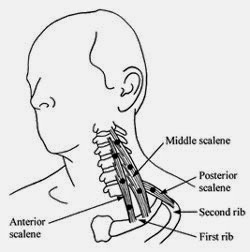
Scalenes are behind the sternocleidomastoid (SCM).
To reach the anterior scalene, with your opposite hand, you have to push the sternocleidomastoid aside toward your throat to locate it between the sternocleidomastoid and the neck vertebrae.  

© Clair Davies
Get your fingertips in front of the vertebrae and push the anterior scalene against the vertebrae up behind your ear and down to the collarbone (clavicle).  If you feel the pulse, just get out of the way.  You will feel tenderness if trigger points are active.  You might find the worst one behind the collarbone.  It is normal to feel a referred sensation somewhere else or mild nervy sensation.  Stroke on each trigger point side to side up to six times.

To locate the middle scalene is easier.  Get your fingertips on the side of the neck vertebrae.

The posterior scalene is buried almost behind the collarbone and tricky to find.  Find where your collarbone meets the top ridge of the shoulder, and move toward the throat along the collarbone. 

© Clair Davies
When you press downward toward the collarbone, you feel a bony structure underneath.  The posterior scalene is around there, and it feels ropy and moves around.  It brings to me a mild nervy sensation, not tenderness, and sends a referred sensation to my back at the inner edge of the shoulder blade.  It may not be comfortable first, but if you don’t find trigger points in the anterior and middle scalenes, this posterior scalene is the key, so don’t be discouraged.  

Apr 28, 2015

Pain Source in the Neck (1) - Scalenes


It seems that these particular muscles in the neck is the solution to many problems in the upper body.  It’s called scalenes (SKAY-leenz) and located in each side of the neck, next to the vertebrae.  I never forget to work on these hidden muscles in the neck. 
Many people avoid touching the neck or don’t want it touched.  However, working on these muscles solves so many pain problems in the upper body.
© Clair Davies
  • Upper back pain (the inner edge of the shoulder blade)
  • Mid back pain
  • Chest pain
  • Front, side and back of shoulder pain
  • Front and back of arm pain/numbness
  • Pain, numbness, tingling, swelling in the arm and hand; symptoms of thoracic outlet syndrome 
Scalenes consist of three muscles (anterior, middle, and posterior), and attach to the sides of neck vertebrae and to the first and the second ribs. 

© Clair Davies
They help support the weight of the head, and flex and turn the neck, but the main job is to lift the ribs when you inhale, so it has to do with breathing.  Breathing shallowly with the chest because of emotional tension or respiratory problems stress the scalenes.  However, daily activities like working with arms out in front of the body, pulling, lifting, and carrying a heavy back pack, and sports activities also easily overtax the muscles.

If you have one (or more) problems above, let’s focus on your neck first.  In the next post, I will show you how to massage the scalenes.      

Nov 11, 2014

FAQ: Does a massage therapist work on my buttocks?


When my clients have a lower back problem, I always work on their buttocks; gluteal muscles.  The area is very important to be addressed because there are many trigger points to relieve pain in the low back, hip, and thigh, piriformis syndrome (the symptoms similar to sciatica)and numbness in the leg.  Good massage therapists know the benefits of gluteal work and aren’t hesitant to work in the area.  I strongly recommend your buttocks be worked on if you have problems mentioned above.  I work on the area over the sheets if a client wears underwear.  I can’t apply smooth gliding strokes, but I can use compressions and other techniques, which are as effective as ones directly on the body.  However, if I work on the tissue directly, I would be able to feel the trigger points and adhesions more accurately, and the strokes would feel smoother to you. 

Here is an example video of how a massage therapist works on the buttocks area.  It's long and technical, so you can fast-forward it.  I don't do exactly the same way, but this will give you a general idea of how a massage is done. 

The important thing for you is to be comfortable and make the most out of your massage session.  Don’t feel pressured to agree on what you don’t feel like.  If your therapist is good, they never insist on their own agendas. 

Sep 12, 2014

Trigger Point Therapy: Part 2 - Referred Pain

I am fascinated by trigger points because of the relationship between pain and its trigger point.  A trigger point sends pain somewhere else, called “referred pain.”  The pain you feel is not where a trigger point is (the source of the pain), but it is referred from the trigger point, which can be far away from where you feel pain.  The relationship between a trigger point and its referred pain is still a mystery, but the patterns are very predictable, and here is The Trigger Point & Referred Pain Guide.