Showing posts with label migraine. Show all posts

Dec 24, 2016

Do You Have Migraines? Have You Tried This Method?

Headaches and migraines are the most common, yet very distressing condition that many people get.  I’ve written many posts about headache relief.  Recently, I gained better insight into migraines from webinars and articles by Til Luchau, LMT.  

Migraines were thought to be caused by dilated blood vessels of the brain.  However, it is now being viewed as a nervous system disorder, along with other factors.  A goal of massage or bodywork is to reduce the compression on the cranial nerves. 

One of the ways you can try to relieve migraine pain is pulling your ears.  When you pull your ears, you also pull the temporal bones slightly. Deep behind the temporal bone is the trigeminal nerve, the likely cause of migraines and cluster headaches.  Pulling the ears might help relieve the pressure on the trigeminal nerve.  You should experiment which angle of the pull relieves the pain better; straight to the side, up, down, back and etc.  Once you found the right angle, hold the traction and relax for a while. I hope this will work for you.


If you are interested in finding more details and other ways to relieve migraine pain, read the article here.  It is designed for massage therapists/bodyworkers, but you can try yourself or ask your massage therapist if they are familiar with the techniques.

Nov 20, 2015

Herbal Teas for Headaches (2) - Let’s Make Tea!

Making tea from bulk herbs is easier than you think.  Above all, it tastes much better!

HERBS
I would highly recommend you buy dried BULK herbs at a health food store with a bulk section, especially ORGANIC ones (unless you have fresh herbs in your garden).  First, you know what you are getting because I’m not really sure about the quality of herbs in tea bags.  You must have experienced that tea made from loose leaf tastes and smells much better than one from a tea bag.  I tried green tea bags from different brands, but it doesn’t taste anything like real green tea, so I am always wondering if manufactures use low grade tea leaves or herbs for tea bags.

Buying herbs in bulk also gives you many advantages.  You can find more varieties of herbs, and buy only the amount you want.  You can also pick the specific herbs most beneficial for your condition and blend them exactly the way you like.  Lastly, it definitely saves you a lot.

EQUIPMENT
You can find all kinds of tea pots and cups with an infuser in stores.  If you don’t have any of these, you can use a mug and strain the herbs with a strainer later.  I use a French coffee press for making more than one cup, but I usually use one very similar to this in the picture below from Zen Formosa (I don’t remember the brand of mine, since it’s been years since I bought it).  It’s even easier than making a cup of coffee.
INSTRUCTIONS
Amount
In the book “20,000 Secrets of  Tea – The Most Effective Ways to Benefit from Nature’sHealing Herbs” by Victoria Zak, a heaping tablespoon of bulk herbs is required, but I feel it’s too much. I normally use about ½ to 1 teaspoon, and it still comes out pretty strong depending on the herbs.  You might want to start with ½ teaspoon to get used to the taste.

If you use fresh herbs (softer and hard parts of a plant), cut the herbs into small pieces and use 2 tablespoons per cup.   

Steeping time
Pour boiled water to a pot or a cup, and cover.  Steep for 3-5 minutes for dried herbs, 7-10 minutes for softer parts of fresh herbs.  For hard parts of fresh herbs such as bark, twigs, seeds, roots, or rhizomes, put pieces of the herb in a pot, cover it with cold water, and bring the water to a boil.  Simmer for 1 hour.

Sugar/Sweeteners
The author of the book doesn’t encourage you to sweeten tea if you take herbal teas as healing remedies.  I agree.  I enjoy the earthy, bitter flavor of herbs, which tastes almost like medicine.  It’s psychological, but I feel like it works better that way.

Enjoy a blissful cup of tea!

Nov 13, 2015

Herbal Teas for Headaches (1) - Herbs


In the last post “Herbal Teas for Healing,” I talked about great healing benefits of herbal teas.  I’m going to introduce the herbs recommended for headaches, migraines and sinuses from the book "20,000 Secrets of  Tea – The Most Effective Ways to Benefit from Nature’s Healing Herbs” by Victoria Zak.  You will be surprised to find some of the herbs are already in your pantry!  In the next post, you will find my tips on how to make tea from bulk herbs, which I strongly recommend.
This guide is for your information only.  
Please see an herbalist if you need professional assistance.

HEADACHES/MIGRAINES

Feverfew “Manna for Migraines and Allergies” (headaches & migraines)
  • Inhibits histamine release and relax blood vessels and nerves.   
  • A liver stimulant – Liver weakness is associated with headaches.
  • Other values: Anti-inflammatory; uterine stimulant; digestive stimulant; brings on menstruation; expels worms
  • *Caution: Don’t use it if you take blood-thinning medication.
Lavender “The Herb of Harmony” (headaches & migraines)
  • Calms and steadies your nerves.
  • Other values: Analgesic; antibacterial; antiseptic; antispasmodic; carminative; nerve tonic
Milk Thistle/Silymarin “The Herb of Renewal” (headaches)
  • Strengthens your liver – Liver deficiency is linked to recurring headaches.
  • Helps to suppress the release of histamines
  • Other values: antiallergenic; antitoxin; anti-aging
Rosemary “The Gentle Revitalizer” (headaches)
  • Relaxes your nervous system
  • Other values: Antiseptic; antioxidant; expectorant; decongestant; circulatory tonic; digestive tonic; astringent; carminative; antispasmodic; antidepressant; diuretic
Ginkgo, parsley, peppermint (topical use), and wood betony also work for headaches.

SINUS CONGESTION

Feverfew: See above
Thyme “The Knockout Infection Fighter”
  • The most powerful antiseptic (antiviral, antibiotic, antifungal, antimicrobial) herb
  • Other values: Antibacterial; antispasmodic; astringent; broncho-dilator; carminative; decongestant; diaphoretic; expectorant; emmenagogue; tonic; expels worms
Bayberry, fenugreek, goldenseal, and plantain (not the banana-like plant) also work.


Dec 2, 2014

Relieve Headache with Trigger Point Massage: Summary


The sources of my trigger point information is mainly from The Trigger Point Therapy Workbook by Clair Davies, which is based on Myofascial Pain and Dysfunction: The Trigger Point Manual, Volumes 1 and 2 by Drs. Janet Travell and David Simons.  This is like the Bible of Trigger Point Therapy.  Any information you find on trigger point therapy is all based on and adapted from these indispensable books. 

You can refer to: The Trigger Point & Referred Pain Guide, which I also introduced in my post, “Trigger Point Therapy: Part 1.”  This website has reproductions of the images (copyrighted) from the Travell & Simon books, and shows trigger points and their referred pain pattern.    


Here is the summary of the headaches I covered. 
Other Symptoms in Head and Neck (will take you to The Trigger Point & Referred Pain Guide) 

I hope you are able to relieve your symptoms yourself.

Nov 7, 2014

Relieve Headache with Trigger Point Massage: Temple Headache (2) / Migraine


The trigger points in the next three muscles cause a temple headache, which may be a typical experience of a migraine headache. 

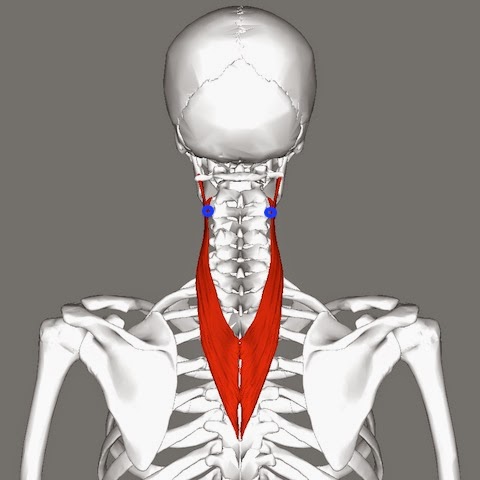
1) splenius cervicis (SPLEE-nee-us SUR-vuh-sis)
splenius cervicis
It is different from the splenius capitis mentioned in the crown headache.  The splenius cervicis doesn’t attach to the skull, but connect the vertebrae of the upper back to those of the neck.  The trigger point in the upper muscles indicated in the blue circles causes the pain coming from the base of the skull, through the head to the back of the eye.  It feels like throbbing pain inside the skull.