Showing posts with label stress. Show all posts

Jul 9, 2016

Calm Your Anxiety with Breathing Exercises


When we have stress, anxiety, and worries, we don’t breathe normally.  Shallow breathing could cause a panic attack for some people.  Keeping breathing under control not only calms our anxiety, but also transforms our life.    

There are many breathing exercises available.  I came across the book called Healing Power of the Breath.  It explains various breathing techniques and their benefits in different conditions or situations from trauma to relationships.  It emphasizes that breath is a “portal to the mind-body system.”  
Messages from the respiratory system have rapid, powerful effects on major brain centers involved in thought, emotion, and behavior. 
The exercises are very simple.  I found it more helpful to listen to the audio and follow the guiding cues to do the exercises.  

I will introduce 3 basic techniques.

1. Coherent Breathing
A rate of 5 breaths per minute- 5 bpm (inhaling for 6 seconds and exhaling for 6 seconds). 
Purpose: To increase Heart Rate Variability (HRV) by changing the pattern of breathing.  The higher HRV, the more flexible cardiovascular system and more resilient stress-response system.

If you were to learn one breathing technique, choose Coherent Breathing.  It helps relieve stress, tension, anxiety, worry, phobias, insomnia, and respiratory problems. 

  • Sit or lie down in a comfortable position. 
  • Close your eyes and mouth, and breathe through your nose. 
  • Breathing should be very slow, gentle and comfortable, not forced.
  • Play the practice. (If 5 bpm is too slow, play the beginning of this practice at 6 bpm.)


2. Resistance Breathing
Any kind of breathing that creates resistance to the flow of air (by pursing the lips, hissing, tightening the throat and etc.)

Purpose: To stimulate the parasympathetic nervous system by the increased pressure in the lungs, inducing relaxation. (Like cats purr!)


3. Breath Moving
With imagination, moving breath and awareness to different parts of the body
Purpose: To improve the circulation of energy through the nervous system and improve blood flow. (In Easter traditions, to open chakras and dissolve blockages so energy can circulate more freely.)

I personally like Breath Moving because I am a visual person.  When I am lying down, I can easily picture the breath as waves coming in and going out.


Total Breath
The combination of Coherent Breathing, Resistance Breathing, and Breath Moving.
Purpose: To maximize effectiveness and rapidity of response.
The book recommends you practice once a day for at least 20 minutes with full concentration. 
 
Body Scan
After breathing practices, finish with Body Scan to allow your system to consolidate the effects.  You can choose any other form of relaxation (meditation, visualization, deep prayer, and etc.).  It helped me calm down better because following the practices makes me more alert than relaxing.   

If you would like to know other healing breath practices including vibration breathing, and also make these great breathing practices your routine, download the audio files here to your device.  The book has much more information, and includes a helpful chart “How and When to Use Each Practice” in the appendix.

Hope these breathing practices transform your life!
            
These audio files are for your own personal use only.

Jul 4, 2016

FAQ: Why is tension carried in the shoulders?


Many of us seem to carry tension in the shoulders as if the whole world rests on our shoulders.  That’s right.  We often feel like it, with so many responsibilities, urgent tasks, and uncertainty for the future.  But, why in the shoulders?

It seems the main cause is mechanical – poor posture.  Most of us spend too much time sitting with the head forward or down and the hunched back.  Since we keep the same position for a long time, the muscles in the upper back are stretched out while the chest and abdominal muscles are short and tight.  Both stretched-out and short muscles cause problems.

From the perspective of body-mind connection, muscle tension and nervous tension are hand in hand.  Mental stress triggers the muscle tension, and the muscle tension causes discomfort leading to stress.  It goes both ways and is a vicious cycle.  Some degree of muscle tension or nervous tension is normal and even necessary.  However, if it’s happening constantly and becoming a habit, it will do more harm than good. 

When we are anxious, worried, upset, or distressed, we experience faster and shallower breathing as well as other fight-and-flight responses.  We sometimes hold our breath.  Thus, the chest has to work rather than the diaphragm,  a large muscle below the lungs to control breathing (read more about the diaphragm in this post).  To move the chest up, the muscles attached between the neck and the ribs or shoulder blades have to do more work.  If the condition persists, the shoulders stay tensed up. 

A small step to reduce shoulder and neck tension is to catch ourselves in the poor posture and under stress/anxiety.   Do the exercise for upper body, and breathe slowly from your stomach (read the next post about breathing exercises).  And, get a massage to relax!  We deserve a break from carrying the world. 

May 4, 2016

Shinrin-yoku – Forest Bathing

   © Naoko Otani

Shinrin-yoku (森林浴): A visit to a forest for relaxation and healing

I was lucky to have grown up close to nature for the Japanese, who live in a crowded city.  My parents frequently took me to the mountains, rivers and lakes.  I loved the sound of rivers and sweet smell of earthy air in the forest and mountains.  I feel at home when I’m in the woods because that’s where I can totally relax, get energized, and, above all, feel being part of the universe. 

I often heard of the term, shinrin-yoku, in Japan, so I was surprised to come across this Japanese word in English articles recently.  It’s no surprising that being in nature makes us feel better and relaxed.  However, the recent studies show scientific evidence that being exposed to the forest air has positive physiological effects.  In Japan, as of now, there are 64 accredited areas and trails for shinrin-yoku therapy.

Major effects noted in the studies are:
  • Boosted immune system: increased natural killer (NK) cell activity, the number of NK cells, and levels of anti-cancer proteins
  • Reduced stress: lowered cortisol (stress hormone) and pulse rate
  • Lowered blood pressure
  • Greater parasympathetic nerve activity  

The effects in the studies are often associated with phytoncides, aromatic volatile organic compounds released from trees and plants.  However, forest environments affect us through all of our senses: sight of scenery, smell of wood and flowers, sound of running streams, chirping birds, or the rustle of leaves, feel of grass and trees, and for some people, taste of edible plants.   

Let’s head out for the forests and relax! 

No time right now?  Watching a 5-minute Forest Therapy Break made by Association of Nature and Forest Therapy Guides and Programs might help you relax.


Jul 21, 2015

FAQ: Why Massage Makes Us Feel Good?


Touch is the most important foundation of massage therapy.  I have written about how touch affects body and mind in “Touch,” “Benefits of Massage,” “Human Touch” and the Japanese post “スキンシップで幸せになろう.”  Now that recent studies prove that touch is good for us, I will sum it up from a scientific point of view. 

When we receive positive touch, two (at least) physiological reactions happen to us.  First, the parasympathetic nervous system is activated.  The parasympathetic nervous system is our home base and helps us back to healing mode, “rest-and-digest,” decreasing the “fight-or-flight” stress response.  Consequently, we experience the sense of relaxation and contentment.

Secondly, oxytocin, so called the “love hormone,” made in the hypothalamus in the brain, is released.  It immediately makes us feel calm and connected to the environment and people around us.  It contributes to relaxation, healing, trust-building, and psychological stability.  One of the studies on oxytocin and massage concluded that “massage increases OT (oxytocin) and decreases ACTH (adrenocorticotropin hormone)”  (ACTH is a hormone often produced in response to emotional and physical stress.)

We don’t have to have pain or tight muscles to receive a massage.  Without knowing it, we deal with stress (big or small) all the time or are getting ready for the next stressful moment.  Massage gives us a break.  Let’s make a feel-good-experience a habit to better our life.

May 1, 2015

Pain Source in the Neck (2) – How to Massage Scalenes


It is important to know how to massage these key muscles for many problems as mentioned in the last post.  Don’t be afraid of touching your neck.  You may want to lie down while massaging so that your neck gets relaxed.   

Scalenes are behind the sternocleidomastoid (SCM).
To reach the anterior scalene, with your opposite hand, you have to push the sternocleidomastoid aside toward your throat to locate it between the sternocleidomastoid and the neck vertebrae.  

© Clair Davies
Get your fingertips in front of the vertebrae and push the anterior scalene against the vertebrae up behind your ear and down to the collarbone (clavicle).  If you feel the pulse, just get out of the way.  You will feel tenderness if trigger points are active.  You might find the worst one behind the collarbone.  It is normal to feel a referred sensation somewhere else or mild nervy sensation.  Stroke on each trigger point side to side up to six times.

To locate the middle scalene is easier.  Get your fingertips on the side of the neck vertebrae.

The posterior scalene is buried almost behind the collarbone and tricky to find.  Find where your collarbone meets the top ridge of the shoulder, and move toward the throat along the collarbone. 

© Clair Davies
When you press downward toward the collarbone, you feel a bony structure underneath.  The posterior scalene is around there, and it feels ropy and moves around.  It brings to me a mild nervy sensation, not tenderness, and sends a referred sensation to my back at the inner edge of the shoulder blade.  It may not be comfortable first, but if you don’t find trigger points in the anterior and middle scalenes, this posterior scalene is the key, so don’t be discouraged.  

Apr 28, 2015

Pain Source in the Neck (1) - Scalenes


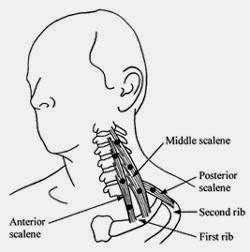
It seems that these particular muscles in the neck is the solution to many problems in the upper body.  It’s called scalenes (SKAY-leenz) and located in each side of the neck, next to the vertebrae.  I never forget to work on these hidden muscles in the neck. 
Many people avoid touching the neck or don’t want it touched.  However, working on these muscles solves so many pain problems in the upper body.
© Clair Davies
  • Upper back pain (the inner edge of the shoulder blade)
  • Mid back pain
  • Chest pain
  • Front, side and back of shoulder pain
  • Front and back of arm pain/numbness
  • Pain, numbness, tingling, swelling in the arm and hand; symptoms of thoracic outlet syndrome 
Scalenes consist of three muscles (anterior, middle, and posterior), and attach to the sides of neck vertebrae and to the first and the second ribs. 

© Clair Davies
They help support the weight of the head, and flex and turn the neck, but the main job is to lift the ribs when you inhale, so it has to do with breathing.  Breathing shallowly with the chest because of emotional tension or respiratory problems stress the scalenes.  However, daily activities like working with arms out in front of the body, pulling, lifting, and carrying a heavy back pack, and sports activities also easily overtax the muscles.

If you have one (or more) problems above, let’s focus on your neck first.  In the next post, I will show you how to massage the scalenes.      

Dec 28, 2014

Create Space and Let Things Happen


The end of the year is coming, so it’s time to reflect the things happened this year.  Stepping back and looking at yourself will hopefully create more space in your mind in this hectic time of the year.

My client’s word struck me one day: She said “One of these days, I want to come here and say, ‘I want to get a relaxation massage!’”  Like many people, she wants to relieve her neck and low back pain.  Everybody wants to be free from pain.  And, it’s logical to only focus on the part of the body that is causing the problem because you don’t want to waste time and money. 

This makes me wonder whether both a therapist and a client are caught up only with “solving the problem.”  Do you focus too much on the problem and even stress yourself out to get better?  If not getting better, are you frustrated with yourself or your therapist for not doing something right?  I wonder if this “stress” or the mind-set somehow prevents you from creating the environment for your body to heal.  What if this is causing the problem to begin with?  We know about the close relationship between body and mind, so your mind plays an important role in healing the body. 

Why don’t you create “space” to let things happen?  Step back, and give yourself a break from your agendas.  Everybody is surprised to find out that a massage to the non-problematic arms, hands and feet is extremely relaxing and therapeutic.  Get a “relaxation” massage and see what happens!

Have a wonderful New Year’s!

Dec 6, 2014

Moist Heat Packs


I like using moist heat packs.  It’s not just warm, but moist.  When it’s moist, the heat penetrates more quickly and deeper.  Primary effects of heat are:
  • Increased supply of oxygen and nutrients and elimination of waste (Vasodilation)
  • Relieves pain (Analgesic) 
  • Relaxes muscle fibers by lengthening
  • Increased circulation
  • Increased metabolism, respiration, and nerve and muscle response
  • Moving blood toward the area treated (Derivation)
  • Brings white blood cells to the area treated (Leukocytosis)

It also helps you calm down (relax the nervous system), so I always recommend it to my clients even at home whenever a heat application is appropriate.   

Here is the important information about when to use heat or ice as using it incorrectly aggravates the condition.