Showing posts with label hand. Show all posts

Oct 5, 2015

That's Not Where It Hurts - Infraspinatus

When you get a massage, you probably have this experience: You didn’t realize some muscle was very tender until it was pressed on.  There are muscles that don’t hurt, but cause pain somewhere else, so you never suspect those muscles are involved.  The scalenes are one of them as introduced in “Pain Source in the Neck - Scalenes.”

Another example is infraspinatus (in-frah-spih-NAH-tus), which causes pain familiar to many people.  The muscle covers the major part of the shoulder blades.  It rotates the arm outwards and helps stabilize the upper arm bone (humerus) in the shoulder joint. 
PAIN PATTERN
If you feel pain in the FRONT of the shoulder, deep in the shoulder joint, or down the biceps, this muscle is in trouble.  Other areas you might feel pain are: the back of the neck, the inner border of the shoulder blade, the forearm, the thumb side of the hand.  And also, if you have weakness and stiffness in the shoulder and arm, restricted movement of the arm, or pain when sleeping on either side, bring your attention to this muscle in the back.  And also, if you are diagnosed with “frozen shoulder,” dysfunction of this muscle among other rotator cuff muscles may be the cause.

CAUSES
Anybody who keeps the arms up in front (driving, typing without elbow support, using the mouse) or overhead (painting, decorating) for long hours, or reaches back repeatedly, is likely to stress this muscle.  And also, many sports activities, accidents and falls may contribute to overload.

TREATMENT
To relieve the condition caused by infraspinatus, you can massage with a tennis ball as explained in “Tennis Ball Massage (1) - Back.”  You can start in the middle of the shoulder blade rolling the ball side to side against the wall.  You might feel the ropy thing and the referred pain in the front of the shoulder (or somewhere else).  If you don’t feel anything, press harder.  For some people, a firmer racquet ball is more effective than a tennis ball.

If you find the tenderness in the middle of infraspinatus, you can use this Ortho-Bionomy release technique.  The following “Release for Shoulder Point 4: Turkey Wing” is referred from “Ortho-Bionomy A Path to Self Care,” the book I introduced in “Look for Comfort –Ortho-Bionomy®.”

  • Stand with your back to the wall, and bend your elbow back.  The position of your elbow should be slightly to the side rather than straight back.
  • Lean your elbow slowly into the wall so that compression is applied from the elbow in toward the shoulder joint.  Relax all the muscles at the shoulder, neck and arm as you lean.  Focus on your sensation.
  • Check the middle of infraspinatus for tenderness.  If it’s still tender, change the elbow position slightly.

Jul 31, 2015

Stretching and Strengthening Exercises at Your Desk (3) - Hands


If you use a computer a lot, you might get wrist pain.  In fact, anybody who use their hands a lot, including massage therapists, are susceptible to carpal tunnel syndrome and tendinitis.  Here are a few tips to prevent them.  

Stretching
The muscles in the inner forearms are constantly flexed to move the fingers.  There are a number of stretching exercises. The easiest one you can do while seated is to use the other hand, and push forward so that the angle of the wrist gets smaller. If you have pain or inflammation, don’t do these exercises.
If you would like deeper and more precise stretching, stand up and put your palm on the desk with the fingers pointing forward.  Pull your thumb and each finger towards you.  This is my favorite.  Here is the video (1:52) showing step by step.

Strengthening
The muscle in the outer forearms should be strengthened.  Hold your hand with the other hand, and try to push forward while the other hand resists. 

Resting Hands Sideways
It is important to have your wrists rest on the desk to support the weight of your forearms.  If you have even a moment to rest your hands while typing, turn your pinky sides down and rest the sides of your hands (a thumb’s up position) on the desk, instead of the hands hovering over the keyboard.  Even this small change might help you in a long run.
Check out exercises for upper body at “Stretching and Strengthening Exercises at Your Desk (1) and (2).”  

Jul 26, 2015

Text Neck

Unfortunately, modern technology is not necessarily doing good for our bodies.  I wrote about a “Forward Head Posture” and “Texting Thumb” a while back.  There is an increasing problem we can’t overlook.

Text Neck” is happening more to younger people, even small children.  It’s not caused by just texting, but using any types of handheld mobile devices including tablets for long periods of time.  Looking down at a device causes the back of the neck overstretched and inflamed.  The common symptoms are headaches, pain in the shoulders, neck, back, arms, elbows, and wrists, and even numbness and tingling of the arms and hands.  Dr. Dean Fishman, who coined the term “Text Neck,” calls this condition “a harmful and dangerous physical condition on the human body. The long term risks can be flattening or reversing the natural spinal curve, early onset of arthritis, spinal degeneration, disc herniations and etc.  This poor posture decreases the lung capacity leading to vascular disease, and puts pressure on the organs causing gastrointestinal problems.  It sounds pretty serious, doesn’t it?

How do we avoid “Text Neck”?  Old habits die hard, but think seriously about the long term consequences especially if you are still young.  Here are suggestions.  

Tablet stands / docking stations:
Use a stand or a docking station to put your device closer to your eye level.

Text Neck Indicator(for Android):
This app alerts you when you tilt a smartphone too low and are at risk for Text Neck.  Unfortunately, I haven’t yet found an app for iPhone.

Look up!
Look up and turn your head left and right 10 times whenever possible.

Do exercises:
Try these exercises I posted at “Stretching and Strengthening Exercises at Your Desk (1) and (2).”       

May 1, 2015

Pain Source in the Neck (2) – How to Massage Scalenes


It is important to know how to massage these key muscles for many problems as mentioned in the last post.  Don’t be afraid of touching your neck.  You may want to lie down while massaging so that your neck gets relaxed.   

Scalenes are behind the sternocleidomastoid (SCM).
To reach the anterior scalene, with your opposite hand, you have to push the sternocleidomastoid aside toward your throat to locate it between the sternocleidomastoid and the neck vertebrae.  

© Clair Davies
Get your fingertips in front of the vertebrae and push the anterior scalene against the vertebrae up behind your ear and down to the collarbone (clavicle).  If you feel the pulse, just get out of the way.  You will feel tenderness if trigger points are active.  You might find the worst one behind the collarbone.  It is normal to feel a referred sensation somewhere else or mild nervy sensation.  Stroke on each trigger point side to side up to six times.

To locate the middle scalene is easier.  Get your fingertips on the side of the neck vertebrae.

The posterior scalene is buried almost behind the collarbone and tricky to find.  Find where your collarbone meets the top ridge of the shoulder, and move toward the throat along the collarbone. 

© Clair Davies
When you press downward toward the collarbone, you feel a bony structure underneath.  The posterior scalene is around there, and it feels ropy and moves around.  It brings to me a mild nervy sensation, not tenderness, and sends a referred sensation to my back at the inner edge of the shoulder blade.  It may not be comfortable first, but if you don’t find trigger points in the anterior and middle scalenes, this posterior scalene is the key, so don’t be discouraged.  

Apr 28, 2015

Pain Source in the Neck (1) - Scalenes


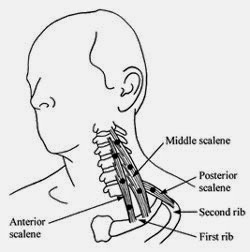
It seems that these particular muscles in the neck is the solution to many problems in the upper body.  It’s called scalenes (SKAY-leenz) and located in each side of the neck, next to the vertebrae.  I never forget to work on these hidden muscles in the neck. 
Many people avoid touching the neck or don’t want it touched.  However, working on these muscles solves so many pain problems in the upper body.
© Clair Davies
  • Upper back pain (the inner edge of the shoulder blade)
  • Mid back pain
  • Chest pain
  • Front, side and back of shoulder pain
  • Front and back of arm pain/numbness
  • Pain, numbness, tingling, swelling in the arm and hand; symptoms of thoracic outlet syndrome 
Scalenes consist of three muscles (anterior, middle, and posterior), and attach to the sides of neck vertebrae and to the first and the second ribs. 

© Clair Davies
They help support the weight of the head, and flex and turn the neck, but the main job is to lift the ribs when you inhale, so it has to do with breathing.  Breathing shallowly with the chest because of emotional tension or respiratory problems stress the scalenes.  However, daily activities like working with arms out in front of the body, pulling, lifting, and carrying a heavy back pack, and sports activities also easily overtax the muscles.

If you have one (or more) problems above, let’s focus on your neck first.  In the next post, I will show you how to massage the scalenes.      

Jan 14, 2015

Contrast Bath – a Hot Tub and a Swimming Pool


This is a side story of the post “Exercise as Part of Your Travel Plans.” 

After the great run in Savannah, a bonus treat was a hot tub at the hotel (I love hot tubs!).  They also had a (cold) swimming pool next to it, so I dipped myself up to the waist cooling the legs and hips until they got slightly numb.  And then, I soaked into the hot tub and massaged the calves, thighs and feet.  I repeated 4 times.  Although my calf had already been sore for a few days, that was gone, and other areas of the legs didn’t get sore next day either.

This is a type of hydrotherapy called a Contrast Bath alternating between hot and cold.  It is more beneficial and powerful than a heat application only.  I already emphasized the benefits of heat in the post “Moist Heat Packs,” but the primary effects of cold are:
  • Reduces inflammation by vasoconstriction
  • Relieves pain (Analgesic/Anesthetic) 
  • Relaxes contracted muscles by decreasing the nerve and muscle response
  • As the secondary effect, reverses the initial responses to return to the body’s normal, uniform, internal stability (homeostasis)
With the alternate hot and cold application, cold constricts the blood vessels, and the blood draws away (vasoconstriction), while heat helps expand the blood vessels, and new, fresh blood draws in (vasodilation).  This repetitive motion acts as a pump to promote great increase in circulation and relieve congestion.  If you apply it to the whole body, it benefits respiration and metabolism as well as circulation.  Because of the benefit of the homeostatic response (warming up to the usual body temperature), it is best to finish with the cold application.    

I now mainly use this hot and cold therapy as preventative maintenance for my hands and forearms; putting my hands into ice water and warm water alternately.  For anybody who works with their hands and fingers, it is highly recommended to avoid injuries.

Dec 28, 2014

Create Space and Let Things Happen


The end of the year is coming, so it’s time to reflect the things happened this year.  Stepping back and looking at yourself will hopefully create more space in your mind in this hectic time of the year.

My client’s word struck me one day: She said “One of these days, I want to come here and say, ‘I want to get a relaxation massage!’”  Like many people, she wants to relieve her neck and low back pain.  Everybody wants to be free from pain.  And, it’s logical to only focus on the part of the body that is causing the problem because you don’t want to waste time and money. 

This makes me wonder whether both a therapist and a client are caught up only with “solving the problem.”  Do you focus too much on the problem and even stress yourself out to get better?  If not getting better, are you frustrated with yourself or your therapist for not doing something right?  I wonder if this “stress” or the mind-set somehow prevents you from creating the environment for your body to heal.  What if this is causing the problem to begin with?  We know about the close relationship between body and mind, so your mind plays an important role in healing the body. 

Why don’t you create “space” to let things happen?  Step back, and give yourself a break from your agendas.  Everybody is surprised to find out that a massage to the non-problematic arms, hands and feet is extremely relaxing and therapeutic.  Get a “relaxation” massage and see what happens!

Have a wonderful New Year’s!

Dec 4, 2014

Power of Touch with a UFO Ball


At massage school, we had an experiment using a UFO Ball. It was a very simple demonstration, but it made a profound impression on me.  The instructor didn’t tell us what was for, so I’m also going to explain the procedures first and the point later.

The UFO Ball is a size of a ping-pong ball, and it has two metal strips embedded.  The instructor held the ball touching one metal strip and asked one of the students to touch the other metal strip with a finger.  Nothing happened.  Then, they held the other hands together while still holding the ball.  Voila!  It lit up and started beeping.  The electricity (or electrons) encircles the two people through their hands, which closed the circuit and activated the battery-operated device in the ball.  

Next, about 20 of us sat in circle on the floor and held hands with the people sitting next to us.  Two of them sitting next to each other in the circle release their hands (still the other hands held) and held the UFO Ball.  One person held the ball touching one metal strip and the other one touch the other metal strip with a finger.  Can you guess what happened?  Yes, it lit up and started beeping.  Why?  Because the electricity traveled through everybody’s hands in the circle and closed the circuit.  And, suddenly, the beeping stopped. The circuit was broken. Somebody in the circle let the hand go. We played with holding and letting go of hands so that light and beeping turned on and off.  

I was excited like a kid.  This can be just a science tool to teach electronic circuits, but it did show that we were connected by touch.  I knew that touch had power to influence the body and mind, but it is easier for me to really “get it” when I can actually see or visualize it. To me, it was amazing to even imagine that electrons were traveling through everybody’s body in a circle and united us. Other than electrons, you never know what else touch facilitates to transfer to other people.  I am re-visiting the power of touch now that I am interested in Craniosacral Therapy.     
      

Nov 20, 2014

Texting Thumb -- De Quervain's Tenosynovitis


I finally bought a smart phone this year and started typing using those tiny keypads (I was never a texter, either).  My thumbs didn’t work, so I used the index finger.  That made my arm and shoulder ache because I had to hold my arm in the air.  But, I wanted to avoid using thumbs because the thumb joint is one of the least stable joints in the body.  Naturally, the thumb injury is the one of the most common injuries for massage therapists. While in massage school, I was told: Save the thumbs for a special occasion.  

There must be many people, especially younger people, who suffer from overuse of their thumbs because of too much texting.  That is one of the common Repetitive Stress Injuries (RSI), De Quervain's Tenosynovitis (dih-kwer-VAINS ten-oh-sine-oh-VIE-tis), also called “texting thumb” among other names.  RSI happen when the same actions occur repeatedly over a period of time, which creates strain on tendons, muscles and joints.  In the case of texting thumb, two tendons running from the back of your thumb down the side of the wrist get swollen and irritated.  It’s also caused by lifting of children, typing, bowling, golf, tennis, fly-fishing, playing the piano, sewing and knitting.  If you have De Quervain's Tenosynovitis or not, you can test (Finkelstein's test).