Showing posts with label approaches. Show all posts

Oct 23, 2015

Facial Massage for Reducing Wrinkles (2) – Facial Tsubo (Acupressure Points)


What are tsubo?  They are also called acupressure points, acupuncture points, acupoints. In Oriental Medicine, there are 14 meridian systems over the entire body, and energy travels through them.  There are 365 tsubo on the human body, and they are “the locations at which it is easy for the flow of energy in the meridian systems to become sluggish and to stagnate.”  Stagnation of energy flow manifests in the tsubo in different ways such as pain, stiffness, and numbness.  When specific tsubo are treated, the flow of energy is restored, and malfunctions will dissipate.

Let’s pamper your face!  Use your favorite facial cream or serum. (Recommended products from my friend who is expert in skincare.) Do not use body lotion for the face if it has fragrance.  The facial skin, especially the eyelids, is much more sensitive than other parts of the body.  If you don’t have face cream at hand, use pure extra virgin olive oil instead.

As I explained in the last post, I referred to “Eliminating Facial Wrinkles” in the book about tsubo therapy by Katsusuke Serizawa, MD.

Around the Eyes (BL-2, TH-23, GB-1, BL-1)
Massage the upper and lower edges of the eye sockets from the inside out.
Cheeks (ST-2)
Massage in the directions of the arrows from ST-2.
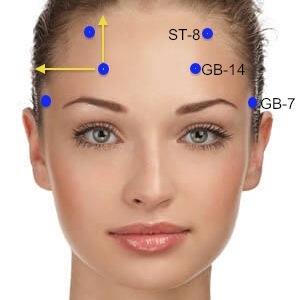
Forehead (GB-14, ST-8, GB-7)
Massage and stroke with the fingertips from GB-14 toward the temples and to the hairline in the directions of the arrows.  Massage in the areas of ST-8 and GB-7. 
Around the Mouth (ST-4, CV-24)
Massage at the corners of the month ST-4, and CV-24 in the directions of the arrows.
Neck (BL-10, LI-17, CV-22)
Raise your chin as high as possible, and use four fingers to massage tsubo on the neck.  Massage in the directions of the arrows extending to the base of the neck.

I didn’t intend to introduce tsubo (acupressure) therapy as a treatment here, so I didn’t explain exactly where each tsubo is located although I indicated the numbers.  If you are curious, you can look up the locations in Atlas of Acupuncture Points (you need to know about the anatomy).

Oct 18, 2015

Facial Massage for Reducing Wrinkles (1) – Causes of Wrinkles


A facial massage is my favorite part of giving massage.  It is always enjoyed by both men and women because it is like a nice surprise.  The facial muscles can be overworked by watching, eating, talking, and making various facial expressions constantly as well as emotional tension.  When the face gets massaged, the whole body tends to relax. 

I found tsubo (acupressure points) for “Eliminating Facial Wrinkles” in the book about tsubo therapy, a type of Shiatsu, by Katsusuke Serizawa, MD.  Although I don’t believe a massage will totally “eliminate” wrinkles, facial massage will definitely promote circulation and cell turnover.

Why do wrinkles develop?  As we get older, the deeper layer of the skin (dermis) in the face diminishes and loses elastin fibers, so it gets less elastic.  And also, the skin can’t retain moisture and produce oil as much and becomes dehydrated.  It all means the skin loses strength and flexibility and tends to wrinkle and sag.  

The facial muscles are unique in the way that one end of the muscles usually attaches to the skin, instead of bone to bone like other muscles.  The facial skin is closely bound together with the tissues of the muscles.  So, the areas where muscles contract often, such as around the eyes, the forehead, and the month, tend to get wrinkled by the skin’s lack of flexibility due to aging.  Other factors for wrinkles are exposure to sun (UV light) and smoking because both speed up the natural aging process.  

Fall is here (even in Florida), and air gets drier, so it is a great idea to combine facial massage and skincare in one.  Daily moisturizing with a massage can help hydrate the skin and stimulate oil gland secretions.

Next post will show you tsubo (acupressure points) in the face for reducing wrinkles. 

Aug 26, 2015

Look for Comfort - Ortho-Bionomy®


I was fortunate to attend the class by Luann Overmyer, a well-known instructor and practitioner of Ortho-Bionomy®.  I heard of the approach and her name when I was still at massage school, but I didn’t know anything about it.

Her biography was pretty intense as she had a near-death experience from a motorcycle accident.  It sounded like a miracle that her body coped with such damage without permanent impairment.  Ortho-Bionomy is what she learned to care, correct, and re-educate her body and mind.  She believes it is the most whole modality. 

Her class was short, but hands-on from the beginning.  Since I didn’t have any prior knowledge, I couldn’t digest what we were doing at that time, but I at least knew the approach was completely different from what I knew and intriguing.  It is an indirect method, so you don’t manipulate soft tissue directly.  Instead, you touch lightly and hold or position parts of the body very gently.

To understand more about what we did in the class, I bought her book “Ortho-Bionomy A Path to Self Care.”  I like anything “self-care” as my first book about massage therapy was “The Trigger Point Therapy Workbook,” and I’ve been writing many posts labeled “self-care.”  I want you to be in charge of your own body and health, what’s going on and what will be good for you.  Her book has a lot of information and self-care exercises.  Unlike The Trigger Point Therapy Workbook, you focus on the most comfortable position where pain subsides, not the pain itself. 

If you try to find pain, you will almost always find it.  We are anticipating pain in a sense, and making it almost like a habit.  Ortho-Bionomy shows you the opposite is true.  “Comfort can be learned as well” said she.  If you try to find comfort, you will find it.  Make the comfort a habit. 

If you want to learn more about Ortho-Bionomy®, go to the official site. 

Aug 4, 2015

FAQ: What is the “Right” Pressure?


Massage therapists ask you about the pressure during a session.  However, if you are still new in massage, you might not know exactly what the “right” pressure should be.  As I wrote in “FAQ: No Pain, No Gain,” some people believe that a massage should give them “good pain,” so to speak, to be effective.  It shouldn’t.

You might think massage therapists should know what pressure is right for you.  Yes, and no.  They do have a good idea based on how your tissue feels like, so they can adjust their pressure accordingly.  However, how your tissue feels like (e.g. tightness) isn’t always a good indication because it is you, who feel it, not your tissue.  You can be very sensitive to touch and can’t stand any deep pressure even if you have tight muscles.  On the other hand, your tissue isn’t tight, but you feel it tense and want stronger pressure.  The perception is relative.  

Another issue is the approach of each massage therapist varies as I mentioned in “Art of Pressure” and “FAQ: Is Deep Tissue Massage painful?”  On top of that, what each of them expects their clients to feel is also different.  I understand that you trust your therapist’s judgment and go along with “not-so-sure-feeling” believing it might do you good in the end.  Or, you just thought that’s what was supposed to feel like. 

I have an embarrassing story when I received a “deep tissue” massage after I became a massage therapist.  The massage was vigorous all the way through, and the pressure was strong, but I thought it was not hurting, and I couldn’t bring myself to tell the therapist to lighten up.  I thought she should know what she was doing.  The outcome was miserable.  I felt “energized” right after the session, but then my body started to get sore everywhere and got even a bruise on that day.  I ended up with pain that I didn’t even have.  I realized our definitions of a “deep tissue” massage were completely different.

You, as a client, should be in charge of what feels right for you.  Trust your “first perception.” (In my case, the pressure was “strong.”)  I remembered that one of the instructors at my massage school said “if you are thinking about pressure during the session, it is probably too much.”  

Jan 31, 2015

FAQ: Does a massage therapist tell me what’s “wrong” with me, and “fix” my problem?


Massage therapists are NOT allowed to diagnose any conditions.  Although more and more massage therapists work in clinical settings, they can only assess the condition, apply “the manipulation of the soft tissues” appropriate for the condition, and possibly suggest self-care you can do at home (the scope of practice varies by state).  Massage therapists cannot say and shouldn’t imply that you have “carpal tunnel syndrome,” for example. 

Some comments from people and even other massage therapists have caught my attention.  It is getting obvious to me that we were taught somewhere that we are “bad” if we have pain, knots, stiffness, or any other soft tissue problems.  It seems to be treated as a disease.  We even label the shoulder or any part of the body which gives us troubles, as “the bad shoulder.”

I understand you can’t help asking this question: “Do I have a knot there?”  It is a natural desire to know the cause of the issue because it’s supposed to be “bad” and should be treated.  Some people take it almost personally, but get relieved to know that many other people have the same problem.  Others seem to give in to the fact as “I-have-lots-of-knots-in-the-shoulder-you-will-see” and are even apologetic as if they did something wrong.    

I started to wonder if massage therapists are the ones educating their clients that they have “bad” knots or “bad” shoulders, so the therapists have to “fix” them.  I was taken aback when one lady told me that her massage therapist vulgarly said her body was “messed up (not the exact word),” so she “had to fix her.”  I wonder if playing a doctor really makes anybody feel better and positive about their body and themselves. 

I believe any massage therapists intend to help their clients feel better.  It’s just that my approach is different (A Holistic Approach explains how my view changed).  First of all, I do not judge no matter how the condition is, by tightness, the numbers of knots and etc.  I accept as it is.  I only feel for them for their discomfort and frustration.  Secondly, I try to use only positive expressions, and avoid negative words, especially “bad.”  I want each of my session a positive experience.  Human body has the innate power to heal itself to maintain equilibrium called “homeostasis.”  As I always emphasize, the body and mind are strongly connected.  My goal is to offer them confidence that they are in charge of their body and can go through a positive change.  I am only here to help, not to “fix.”  

Jan 20, 2015

FAQ: Is Deep Tissue Massage painful?


Some people want to get Swedish Massage to relax, and some love Deep Tissue Massage to feel that their body is surely worked on.  Whatever you choose, all massage is “therapeutic” in the sense that massage influences and promotes your well-being.  

Deep Tissue Massage (I call it Connective Tissue Therapy) seems to be regarded as a somewhat painful method opposed to Swedish Massage.  However, the Connective Tissue Therapy I learned is not intended to push hard or cause pain.  As I explained about fascia and the cornstarch experiment in the previous post “Fascia (Connective Tissue),” I sink in to the tissue slowly only to the degree that the tissue allows me (read about my techniques).  It may not turn out to be “deep” depending on the condition of the tissue, but it is all effective as the superficial fascia still has an effect on the deep fascia.  The work is intended to allow the restricted or dehydrated fascia to become softer and more supple.  The Connective Tissue Therapy invites you to be aware of your body and provides a unique opportunity to discover yourself.  You could experience deeper relaxation because of the slower pace.

Ask your massage therapist first what their “Deep Tissue Massage” is like.  Since massage techniques, methods, and approaches are not clearly defined unless they are registered such as Rolfing®, “Deep Tissue Massage” can be quite different depending on the therapist.  And also, it may be called “Connective Tissue Massage/Therapy,” ”Myofascial Massage,” or something else.  It's important to find one you like, whatever is called.

If you like Deep Tissue Massage, read "No Pain, No Gain?"

Fascia (Connective Tissue)


Fascia was most talked about at massage school, and has been a hot topic in the bodywork field.  Fascia is connective tissue forming a continuous, three-dimensional matrix, and has different forms and many functions.  It surrounds all organs, nerves, blood vessels, muscles and bones.  It also supports the body against gravity, protects, separates and connects structures of the body, enables all movement to happen, communicates, delivers nutrients, and eliminates waste.  Here is a video showing how fascia looks like.  

When you have chronic contraction, repetitive use, emotional distress or poor nutrition, fascia becomes restricted, adhered, or dehydrated.  Since the whole body is connected with fascia, one part of the body may affect other parts as well.  It is like pulling one section of a knitted sweater changes the balance and tension of the threads of yarn of the whole sweater.  The notion of fascia is important for massage therapists because it brings your attention, not only to specific muscles, but to a whole body.

To understand what fascia feels like, we had an experiment at massage school using cornstarch.  You need a small paper cup (for mouthwash), water, and cornstarch.  Put cornstarch in the cup and add enough water to cover the cornstarch.  Wait until the cornstarch is settled at the bottom of the cup.  Then, stick your finger into the cornstarch quickly with force.  The cornstarch gets hardened, so your finger stops on the surface and cannot get it through.  Next, try to stick your finger into the cornstarch slowly and gently without resisting.  This time, your finger can get through the cornstarch and touch the bottom of the cup.  Cornstarch is the fascia.  You can sink into the fascia slowly and gently, but not with force. 

Fascia is the fundamental component in the Connective Tissue Therapy I learned in school.  It touches into the whole person through addressing fascia and the connections to the entire body.  Continue to read “FAQ: Is Deep Tissue Massage painful?”

Jan 16, 2015

Art of Pressure

It seems pretty common that some people got a massage from friends and family, and it got sore or even painful, next day.  The reason why you got hurt next day is your muscle fibers got damaged (bruised) because of too much pressure.  Just because the muscle is tight, you can’t pound on it expecting it getting tender (your body isn’t meat!).  Besides, “No pain, no gain" isn’t always true.  As much as I want to promote self-care, I don’t necessarily recommend your friends and family give you a massage.  It’s not the techniques that they lack,  but the art of pressure, speed and depth, in my opinion.  

I get comments from my clients that the pressure I use is “just right.” I immerse myself in the feel of tissue (it’s a mentally and physically hard work), and I don’t go deeper than what the tissue lets me.  Although we usually talk about “pressure,” it is actually a combination of pressure, speed and depth.  My pace may be a little slower than the average massage therapists’ because I “listen to the tissue” every inch.  It requires both sensitivity of my palpation (touch) and intuition.  It is as if tissue calls out for me to get my attention.  If I move faster, I may miss it.  If something gets my attention, I stop, work on it, and, when I feel a change again, continue.  

I don’t normally analyze what it is, why it is there, or what it means when I notice some change in the tissue, unless I apply Trigger Point Therapy.  The great thing about the massage therapy profession is that massage therapists are not allowed to diagnose – it’s out of the scope of practice.  We can’t name or label what the condition is.  To me, it’s such a freedom because I want to see a person as a whole, not the collection of conditions and symptoms.  Like in the Eastern medicine, you can only find imbalance in the body, whatever it manifests.  

Nov 18, 2014

Cranial Unwinding - My First Observation of Craniosacral Therapy


I am a member of the Florida State Massage Therapy Association, and they offer Continuing Education classes every month for the members.  I like attending their classes because they invite massage therapists who specialize in different techniques and approaches, so it’s a perfect opportunity for me to be exposed and learn new things.

I was intrigued by Paul Pock’s Cranial Unwinding.  Although I had basic knowledge of Craniosacral Therapy (a brief description below), and heard practitioners talking about their experience, it was not on my list, to be honest.  I was not drawn to, so called, energy work.

Oct 23, 2014

A Holistic Approach

I have a holistic view of health and wellness. The word is related to “holism,” which emphasizes the interconnection of the parts reference to the whole, but now it’s strongly associated with medicine.  While Western medicine tends to analyze only the physical symptoms, the holistic approach takes a whole person (mental and social factors) into consideration.  

When I started my massage school, I was only interested in “clinical massage.”   I wanted to offer pain relief because I was always goal-oriented, so I wanted to “fix” their problems once and for all.  However, I learned that massage therapy was more than just fixing problems.  Don't get me wrong; my ultimate goal is still to help clients improve their conditions.  My view changed to the following:

Sep 12, 2014

Trigger Point Therapy: Part 2 - Referred Pain

I am fascinated by trigger points because of the relationship between pain and its trigger point.  A trigger point sends pain somewhere else, called “referred pain.”  The pain you feel is not where a trigger point is (the source of the pain), but it is referred from the trigger point, which can be far away from where you feel pain.  The relationship between a trigger point and its referred pain is still a mystery, but the patterns are very predictable, and here is The Trigger Point & Referred Pain Guide.  

Sep 9, 2014

Trigger Point Therapy: Part 1 - Introduction


I mentioned in "About Me" that the book about Trigger Point Therapy was probably the one of the biggest reasons why I became a massage therapist.  It’s called “The Trigger Point Therapy Workbook” by Clair Davies.  I would flip pages even when I had a little pain.  I was fascinated by the relationship with pain and muscles. 

What I like about the book is that it gives you specific instructions in how to give yourself a massage and relieve pain.  You can treat yourself!  And also, the fact that the author became a massage therapist when he was sixty years old, made me think it’s not too late for me to become a massage therapist.  His curiosity to explore the body and determination to relieve pain for others resonated with me. 

What is a trigger point?
Trigger points were extensively researched by Dr. Janet Travell and Dr. David Simons for over 50 years.  Trigger points are hyperirritable bands in the muscle fibers.  They cause pain at the spot when firm pressure is applied and also refer pain to another site (“referred pain”).  Under an electron microscope, they appear as contracted muscle tissues.