Showing posts with label neck. Show all posts

Jul 4, 2016

FAQ: Why is tension carried in the shoulders?


Many of us seem to carry tension in the shoulders as if the whole world rests on our shoulders.  That’s right.  We often feel like it, with so many responsibilities, urgent tasks, and uncertainty for the future.  But, why in the shoulders?

It seems the main cause is mechanical – poor posture.  Most of us spend too much time sitting with the head forward or down and the hunched back.  Since we keep the same position for a long time, the muscles in the upper back are stretched out while the chest and abdominal muscles are short and tight.  Both stretched-out and short muscles cause problems.

From the perspective of body-mind connection, muscle tension and nervous tension are hand in hand.  Mental stress triggers the muscle tension, and the muscle tension causes discomfort leading to stress.  It goes both ways and is a vicious cycle.  Some degree of muscle tension or nervous tension is normal and even necessary.  However, if it’s happening constantly and becoming a habit, it will do more harm than good. 

When we are anxious, worried, upset, or distressed, we experience faster and shallower breathing as well as other fight-and-flight responses.  We sometimes hold our breath.  Thus, the chest has to work rather than the diaphragm,  a large muscle below the lungs to control breathing (read more about the diaphragm in this post).  To move the chest up, the muscles attached between the neck and the ribs or shoulder blades have to do more work.  If the condition persists, the shoulders stay tensed up. 

A small step to reduce shoulder and neck tension is to catch ourselves in the poor posture and under stress/anxiety.   Do the exercise for upper body, and breathe slowly from your stomach (read the next post about breathing exercises).  And, get a massage to relax!  We deserve a break from carrying the world. 

Oct 23, 2015

Facial Massage for Reducing Wrinkles (2) – Facial Tsubo (Acupressure Points)


What are tsubo?  They are also called acupressure points, acupuncture points, acupoints. In Oriental Medicine, there are 14 meridian systems over the entire body, and energy travels through them.  There are 365 tsubo on the human body, and they are “the locations at which it is easy for the flow of energy in the meridian systems to become sluggish and to stagnate.”  Stagnation of energy flow manifests in the tsubo in different ways such as pain, stiffness, and numbness.  When specific tsubo are treated, the flow of energy is restored, and malfunctions will dissipate.

Let’s pamper your face!  Use your favorite facial cream or serum. (Recommended products from my friend who is expert in skincare.) Do not use body lotion for the face if it has fragrance.  The facial skin, especially the eyelids, is much more sensitive than other parts of the body.  If you don’t have face cream at hand, use pure extra virgin olive oil instead.

As I explained in the last post, I referred to “Eliminating Facial Wrinkles” in the book about tsubo therapy by Katsusuke Serizawa, MD.

Around the Eyes (BL-2, TH-23, GB-1, BL-1)
Massage the upper and lower edges of the eye sockets from the inside out.
Cheeks (ST-2)
Massage in the directions of the arrows from ST-2.
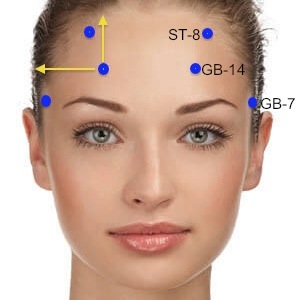
Forehead (GB-14, ST-8, GB-7)
Massage and stroke with the fingertips from GB-14 toward the temples and to the hairline in the directions of the arrows.  Massage in the areas of ST-8 and GB-7. 
Around the Mouth (ST-4, CV-24)
Massage at the corners of the month ST-4, and CV-24 in the directions of the arrows.
Neck (BL-10, LI-17, CV-22)
Raise your chin as high as possible, and use four fingers to massage tsubo on the neck.  Massage in the directions of the arrows extending to the base of the neck.

I didn’t intend to introduce tsubo (acupressure) therapy as a treatment here, so I didn’t explain exactly where each tsubo is located although I indicated the numbers.  If you are curious, you can look up the locations in Atlas of Acupuncture Points (you need to know about the anatomy).

Oct 5, 2015

That's Not Where It Hurts - Infraspinatus

When you get a massage, you probably have this experience: You didn’t realize some muscle was very tender until it was pressed on.  There are muscles that don’t hurt, but cause pain somewhere else, so you never suspect those muscles are involved.  The scalenes are one of them as introduced in “Pain Source in the Neck - Scalenes.”

Another example is infraspinatus (in-frah-spih-NAH-tus), which causes pain familiar to many people.  The muscle covers the major part of the shoulder blades.  It rotates the arm outwards and helps stabilize the upper arm bone (humerus) in the shoulder joint. 
PAIN PATTERN
If you feel pain in the FRONT of the shoulder, deep in the shoulder joint, or down the biceps, this muscle is in trouble.  Other areas you might feel pain are: the back of the neck, the inner border of the shoulder blade, the forearm, the thumb side of the hand.  And also, if you have weakness and stiffness in the shoulder and arm, restricted movement of the arm, or pain when sleeping on either side, bring your attention to this muscle in the back.  And also, if you are diagnosed with “frozen shoulder,” dysfunction of this muscle among other rotator cuff muscles may be the cause.

CAUSES
Anybody who keeps the arms up in front (driving, typing without elbow support, using the mouse) or overhead (painting, decorating) for long hours, or reaches back repeatedly, is likely to stress this muscle.  And also, many sports activities, accidents and falls may contribute to overload.

TREATMENT
To relieve the condition caused by infraspinatus, you can massage with a tennis ball as explained in “Tennis Ball Massage (1) - Back.”  You can start in the middle of the shoulder blade rolling the ball side to side against the wall.  You might feel the ropy thing and the referred pain in the front of the shoulder (or somewhere else).  If you don’t feel anything, press harder.  For some people, a firmer racquet ball is more effective than a tennis ball.

If you find the tenderness in the middle of infraspinatus, you can use this Ortho-Bionomy release technique.  The following “Release for Shoulder Point 4: Turkey Wing” is referred from “Ortho-Bionomy A Path to Self Care,” the book I introduced in “Look for Comfort –Ortho-Bionomy®.”

  • Stand with your back to the wall, and bend your elbow back.  The position of your elbow should be slightly to the side rather than straight back.
  • Lean your elbow slowly into the wall so that compression is applied from the elbow in toward the shoulder joint.  Relax all the muscles at the shoulder, neck and arm as you lean.  Focus on your sensation.
  • Check the middle of infraspinatus for tenderness.  If it’s still tender, change the elbow position slightly.

Jul 26, 2015

Text Neck

Unfortunately, modern technology is not necessarily doing good for our bodies.  I wrote about a “Forward Head Posture” and “Texting Thumb” a while back.  There is an increasing problem we can’t overlook.

Text Neck” is happening more to younger people, even small children.  It’s not caused by just texting, but using any types of handheld mobile devices including tablets for long periods of time.  Looking down at a device causes the back of the neck overstretched and inflamed.  The common symptoms are headaches, pain in the shoulders, neck, back, arms, elbows, and wrists, and even numbness and tingling of the arms and hands.  Dr. Dean Fishman, who coined the term “Text Neck,” calls this condition “a harmful and dangerous physical condition on the human body. The long term risks can be flattening or reversing the natural spinal curve, early onset of arthritis, spinal degeneration, disc herniations and etc.  This poor posture decreases the lung capacity leading to vascular disease, and puts pressure on the organs causing gastrointestinal problems.  It sounds pretty serious, doesn’t it?

How do we avoid “Text Neck”?  Old habits die hard, but think seriously about the long term consequences especially if you are still young.  Here are suggestions.  

Tablet stands / docking stations:
Use a stand or a docking station to put your device closer to your eye level.

Text Neck Indicator(for Android):
This app alerts you when you tilt a smartphone too low and are at risk for Text Neck.  Unfortunately, I haven’t yet found an app for iPhone.

Look up!
Look up and turn your head left and right 10 times whenever possible.

Do exercises:
Try these exercises I posted at “Stretching and Strengthening Exercises at Your Desk (1) and (2).”       

May 29, 2015

Relieve Coughing with Essential Oils


I was just thinking, oh good, I didn’t get bad allergy this year.  I spoke too soon!  Within a few days, I started to get sore throat and the tight sensation in the chest  during night.  Now, I remember I had uncontrollable coughs in the middle of the night and slept with cough candies in the month for several nights last year.  This year, I did differently.

In the last post, I described properties of several essential oils.  One of the properties of eucalyptus essential oil is expectorant, and it's in commercial vapor rubs. 

First, I rinse the nasal cavity with a Neti pot with warm saline solution and 1 drop of eucalyptus oil at least twice a day.  (Update: I found 2 drops may be better although it causes sneezing.)  I made a salve with organic body butter I had and eucalyptus oil.  Before going to bed, I put it on the neck, chest, under my nose, and feet (see below).  The first night I woke up with coughs from tickles in the throat, I put the salve around the throat, and I could go back to sleep without more coughs. 

Next day, I found a recipe and made a different rub with coconut oil, eucalyptus oil, peppermint oil, lavender oil, and tea tree oil.  It is liquid because coconut oil melts in the warm room temperature (I didn’t care for the smell either, so I would use unscented body butter).  Again, I put it on the neck, chest, under my nose and feet. When my throat tickled at night, this time, I massaged gently with the oil along the throat, where it tickled.  The tickling stopped immediately, and I could go back to sleep.  Since then, I haven’t woken up at night from coughs.  The tightness in the chest is gone, but I still feel tickling in the throat at night, so I keep putting on the oil before going to bed.  

The reason I put the salve on the feet is that reflexes on the feet correspond to the parts of the body (reflexology).  The toes and the front and back of the upper feet correspond to sinuses, nose, throat, lungs, chest and lymph.  It also feels really good to massage feet.  I will discuss more about reflexology some other time.

May 1, 2015

Pain Source in the Neck (2) – How to Massage Scalenes


It is important to know how to massage these key muscles for many problems as mentioned in the last post.  Don’t be afraid of touching your neck.  You may want to lie down while massaging so that your neck gets relaxed.   

Scalenes are behind the sternocleidomastoid (SCM).
To reach the anterior scalene, with your opposite hand, you have to push the sternocleidomastoid aside toward your throat to locate it between the sternocleidomastoid and the neck vertebrae.  

© Clair Davies
Get your fingertips in front of the vertebrae and push the anterior scalene against the vertebrae up behind your ear and down to the collarbone (clavicle).  If you feel the pulse, just get out of the way.  You will feel tenderness if trigger points are active.  You might find the worst one behind the collarbone.  It is normal to feel a referred sensation somewhere else or mild nervy sensation.  Stroke on each trigger point side to side up to six times.

To locate the middle scalene is easier.  Get your fingertips on the side of the neck vertebrae.

The posterior scalene is buried almost behind the collarbone and tricky to find.  Find where your collarbone meets the top ridge of the shoulder, and move toward the throat along the collarbone. 

© Clair Davies
When you press downward toward the collarbone, you feel a bony structure underneath.  The posterior scalene is around there, and it feels ropy and moves around.  It brings to me a mild nervy sensation, not tenderness, and sends a referred sensation to my back at the inner edge of the shoulder blade.  It may not be comfortable first, but if you don’t find trigger points in the anterior and middle scalenes, this posterior scalene is the key, so don’t be discouraged.  

Apr 28, 2015

Pain Source in the Neck (1) - Scalenes


It seems that these particular muscles in the neck is the solution to many problems in the upper body.  It’s called scalenes (SKAY-leenz) and located in each side of the neck, next to the vertebrae.  I never forget to work on these hidden muscles in the neck. 
Many people avoid touching the neck or don’t want it touched.  However, working on these muscles solves so many pain problems in the upper body.
© Clair Davies
  • Upper back pain (the inner edge of the shoulder blade)
  • Mid back pain
  • Chest pain
  • Front, side and back of shoulder pain
  • Front and back of arm pain/numbness
  • Pain, numbness, tingling, swelling in the arm and hand; symptoms of thoracic outlet syndrome 
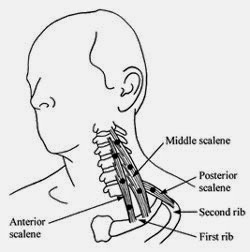
Scalenes consist of three muscles (anterior, middle, and posterior), and attach to the sides of neck vertebrae and to the first and the second ribs. 

© Clair Davies
They help support the weight of the head, and flex and turn the neck, but the main job is to lift the ribs when you inhale, so it has to do with breathing.  Breathing shallowly with the chest because of emotional tension or respiratory problems stress the scalenes.  However, daily activities like working with arms out in front of the body, pulling, lifting, and carrying a heavy back pack, and sports activities also easily overtax the muscles.

If you have one (or more) problems above, let’s focus on your neck first.  In the next post, I will show you how to massage the scalenes.      

Apr 9, 2015

Stretching and Strengthening Exercises at Your Desk (2) - Upper Body Strengthening


When you feel tension or pain, you can’t always think that stretching will help.  In the forward head posture discussed in the last post, while the chest muscles are short, the muscles located the other side in the back are overstretched and weak.  It’s likely you feel tension or pain in the back between the shoulder blades.  You don’t want to stretch already overstretched muscles.  Muscles coordinate with opposing muscles by contracting and relaxing to make every movement.  It is helpful to check your habitual posture to see which muscles are shortened or overstretched.  

Strengthening

While stretching helps shortened muscles, “strengthening” exercises help overstretched, weakened muscles increase muscle tone so that you can restore proper posture.  Here are easy exercises you can do at a desk. 

Upper back: When chest muscles are short, the muscles in the upper back are overstretched.
  • Relax the shoulders.  Squeeze the shoulder blades together without using arms or any muscles other than the ones between the shoulder blades.  Hold each squeeze for 5-10 seconds with 3-5 seconds of rest between squeezes. Repeat 10 times or until you feel fatigue.

Mid-back: The muscles along the spine in the mid back are overstretched.
     
  • Rest your hands behind your head, and lean backwards (extend the spine) within your comfort level.

Front of your neck: As the back of the neck is short and tight, the deep muscles of the front neck are weak.
  • Pull your chin inward and head straight back. Hold it for 5-10 seconds with 3-5 seconds of the rest in between.  Repeat 10 times or until you feel fatigue in the neck.

Apr 4, 2015

Stretching and Strengthening Exercises at Your Desk (1) - Upper Body Stretching


Computer is a great invention, but it created a lot of trouble for us.  Sitting and typing almost all day causes tension or pain all over our body; in the eyes, head, neck, upper shoulder, between the shoulder blades, mid back, lower back, hips, arms, wrists and fingers.  It can lead to the conditions such as tension headaches, thoracic outlet syndrome, functional thoracic hyperkyphosis, and carpal tunnel syndrome. 

Your arms always out in front to type and looking at the monitor changes your posture to a “Forward Head Posture (FHP).”  
It is very difficult to change your habitual posture even if you try.  So, here are a few examples of easy stretching and strengthening exercises, which you can do at desk any time without interrupting your work.  The important thing is to remember to do as often as possible throughout the day.  Find a chance while reading email, listening to a speaker phone, or going to the restroom.

Stretching
Slowly and gently.
Do not force the stretch (pain-free).
Keep other muscles as relaxed as possible.

Back of your neck: When your head is forward, the back of your upper neck gets tight.
  • Let your head hang  (the chin closer to the chest) without forcing it.  Bend only the neck without flexing your upper back.  Hold it for 15-30 seconds.  The stretch should be felt in the back of the neck, not in the upper back.  
  • [Deeper stretch] Rest the hands on the back of the head so the weight of the arms pulls the head down further.
Chest: With your arms out in front, the chest muscles are shortened.
  • Clasp your fingers behind your head or ears (deeper stretch).  Draw the elbows further back until you feel resistance. And, raise your shoulders at the same time. Hold it for 15-30 seconds while taking deep breaths.
  • Clasp your fingers behind your back, and pull them away from you until you feel the nice stretch in the chest. 
Upper body: Your upper body is likely slouchy.  It needs a nice lift-up, so you can also breath better.
  • Clasp your fingers in front of you with the palms facing out.  Slowly raise your hands over your head, and lift up toward the ceiling while breathing in.  Hold it for 5 seconds.  Repeat 3 times.
I will cover strengthening exercises in the next post.

Dec 2, 2014

Relieve Headache with Trigger Point Massage: Summary


The sources of my trigger point information is mainly from The Trigger Point Therapy Workbook by Clair Davies, which is based on Myofascial Pain and Dysfunction: The Trigger Point Manual, Volumes 1 and 2 by Drs. Janet Travell and David Simons.  This is like the Bible of Trigger Point Therapy.  Any information you find on trigger point therapy is all based on and adapted from these indispensable books. 

You can refer to: The Trigger Point & Referred Pain Guide, which I also introduced in my post, “Trigger Point Therapy: Part 1.”  This website has reproductions of the images (copyrighted) from the Travell & Simon books, and shows trigger points and their referred pain pattern.    


Here is the summary of the headaches I covered. 
Other Symptoms in Head and Neck (will take you to The Trigger Point & Referred Pain Guide) 

I hope you are able to relieve your symptoms yourself.