Showing posts with label pain. Show all posts

Dec 3, 2016

Diaphragm and Digestive Dysfunction (Heartburn/GERD/Acid Reflux/Hiatal Hernia)

I have become more and more aware that breathing is an important part of health and wellness.  I talked about the relationship with anxiety in the last post.  Anxiety is not only mental distress, but can cause muscle tension, chest pain, and digestive disorders

The diaphragm is a unique dome-shaped muscle controlling breathing.  It is located horizontally separating the thoracic cavity (containing lungs, heart and etc) and the abdominal cavity (stomach, liver, intestines and etc.).  The esophagus, vena cava, and aorta pass through the middle of it.

With proper breathing, the diaphragm contracts when we inhale, moving down and expanding the thoracic cavity to suck the air in, and the diaphragm completely relaxes when we exhale.  We do this about 26,000 times a day.
If we have shallow chest breathing, where the diaphragm can’t fully contract and relax, it loses the elasticity and tightens like any other muscles. The dysfunction of the diaphragm could cause adhesion with the stomach, or squeeze the esophagus, causing digestive disorders like GERD and hiatal hernia.

Here is how it happens.
Anxiety/stress   Incorrect breathing (shallow breathing)   Diaphragm dysfunction ➜ Stomach dysfunction   Digestive disorders 
I found very helpful and comprehensive videos about understanding heartburn and GERD and an abdominal massage for hiatal hernia.  Although I never had hiatal hernia, massaging the middle of the stomach right below the breastbone and rib cage has been effective for me to relieve the pain in the upper stomach because of indigestion.

It is important to massage other abdominal muscles (will post in the future) and use the breathing exercises in order to maintain the healthy digestive functions.


Jul 4, 2016

FAQ: Why is tension carried in the shoulders?


Many of us seem to carry tension in the shoulders as if the whole world rests on our shoulders.  That’s right.  We often feel like it, with so many responsibilities, urgent tasks, and uncertainty for the future.  But, why in the shoulders?

It seems the main cause is mechanical – poor posture.  Most of us spend too much time sitting with the head forward or down and the hunched back.  Since we keep the same position for a long time, the muscles in the upper back are stretched out while the chest and abdominal muscles are short and tight.  Both stretched-out and short muscles cause problems.

From the perspective of body-mind connection, muscle tension and nervous tension are hand in hand.  Mental stress triggers the muscle tension, and the muscle tension causes discomfort leading to stress.  It goes both ways and is a vicious cycle.  Some degree of muscle tension or nervous tension is normal and even necessary.  However, if it’s happening constantly and becoming a habit, it will do more harm than good. 

When we are anxious, worried, upset, or distressed, we experience faster and shallower breathing as well as other fight-and-flight responses.  We sometimes hold our breath.  Thus, the chest has to work rather than the diaphragm,  a large muscle below the lungs to control breathing (read more about the diaphragm in this post).  To move the chest up, the muscles attached between the neck and the ribs or shoulder blades have to do more work.  If the condition persists, the shoulders stay tensed up. 

A small step to reduce shoulder and neck tension is to catch ourselves in the poor posture and under stress/anxiety.   Do the exercise for upper body, and breathe slowly from your stomach (read the next post about breathing exercises).  And, get a massage to relax!  We deserve a break from carrying the world. 

Oct 5, 2015

That's Not Where It Hurts - Infraspinatus

When you get a massage, you probably have this experience: You didn’t realize some muscle was very tender until it was pressed on.  There are muscles that don’t hurt, but cause pain somewhere else, so you never suspect those muscles are involved.  The scalenes are one of them as introduced in “Pain Source in the Neck - Scalenes.”

Another example is infraspinatus (in-frah-spih-NAH-tus), which causes pain familiar to many people.  The muscle covers the major part of the shoulder blades.  It rotates the arm outwards and helps stabilize the upper arm bone (humerus) in the shoulder joint. 
PAIN PATTERN
If you feel pain in the FRONT of the shoulder, deep in the shoulder joint, or down the biceps, this muscle is in trouble.  Other areas you might feel pain are: the back of the neck, the inner border of the shoulder blade, the forearm, the thumb side of the hand.  And also, if you have weakness and stiffness in the shoulder and arm, restricted movement of the arm, or pain when sleeping on either side, bring your attention to this muscle in the back.  And also, if you are diagnosed with “frozen shoulder,” dysfunction of this muscle among other rotator cuff muscles may be the cause.

CAUSES
Anybody who keeps the arms up in front (driving, typing without elbow support, using the mouse) or overhead (painting, decorating) for long hours, or reaches back repeatedly, is likely to stress this muscle.  And also, many sports activities, accidents and falls may contribute to overload.

TREATMENT
To relieve the condition caused by infraspinatus, you can massage with a tennis ball as explained in “Tennis Ball Massage (1) - Back.”  You can start in the middle of the shoulder blade rolling the ball side to side against the wall.  You might feel the ropy thing and the referred pain in the front of the shoulder (or somewhere else).  If you don’t feel anything, press harder.  For some people, a firmer racquet ball is more effective than a tennis ball.

If you find the tenderness in the middle of infraspinatus, you can use this Ortho-Bionomy release technique.  The following “Release for Shoulder Point 4: Turkey Wing” is referred from “Ortho-Bionomy A Path to Self Care,” the book I introduced in “Look for Comfort –Ortho-Bionomy®.”

  • Stand with your back to the wall, and bend your elbow back.  The position of your elbow should be slightly to the side rather than straight back.
  • Lean your elbow slowly into the wall so that compression is applied from the elbow in toward the shoulder joint.  Relax all the muscles at the shoulder, neck and arm as you lean.  Focus on your sensation.
  • Check the middle of infraspinatus for tenderness.  If it’s still tender, change the elbow position slightly.

Sep 4, 2015

Use Caution with Muscle Pain Relief Products


I recently heard that over-the-counter muscle pain relief products could be toxic.  I looked it up myself, and found many muscle pain relief products contain methyl salicylate (and menthol) and can be harmful if misused or overused.  Believe it or not, there is one case of death from overuse of Bengay.  

Methyl salicylate is naturally produced by wintergreens known as wintergreen oil, or synthetically produced.  It is toxic in pure form (like many medicinal properties), and found in high concentrations in deep heating liniments.  It mainly works as a “counterirritant,” which heats up and cools the skin, so you feel more of the sensation rather than the pain you originally had.  It may be effective more for acute pain than chronic pain.

Some of the muscle pain relief brand names (generic name: menthol/methyl salicylate topical) are: Bengay, Icy Hot, Mentholatum D, Salonpas Pain Patch, and many sold as “muscle rub.”

Like any other over-the-counter products, it is safe as long as you follow the directions, but harmful or deadly if overused (like taking too many sleeping pills).  I am just trying to caution you because it might be very easy to use a muscle pain relief product too much or too often when you are constantly in pain.  You must:   
  • Read the entire information, Warnings, and Directions of the product before using it.  
  • Check if your medication (especially, blood thinning medications, NSAIDs, and steroids) may interact with menthol/methyl salicylate topical.  
  • Don’t use it with a heating pad, or under a tight bandage.
  • Use it temporarily, and see your doctor if the problem persists.    

*If you use “natural” products containing wintergreen oil, same caution should apply.

Aug 29, 2015

Listen to Our Innate Wisdom


INNATE WISDOM or INNER DOCTOR: I have heard of these words many times by now, and it also relates to the introduction of “Ortho-Bionomy A Path to Self Care” by Luann Overmyer mentioned in the last post.  In the holistic approach, maintaining equilibrium within us is important for our well-being.  We do have an INNATE WISDOM or INNER DOCTOR in us to heal ourselves, self-regulate and balance itself.  Have you recently listened to your innate wisdom?

When it comes to our health care, we are used to being told what is wrong, and what to do by health care professionals.  And, medical professionals rarely ask us what we have to say about our pain or discomfort.  When one client tried to tell his doctor what he thought was wrong, he was silenced by “Are you a doctor?”  I would say, “yes, everybody has a doctor within!” 

Some people are aware of what their body needs, but most people don’t know how or never thought about it.  Next time you feel discomfort or pain, I encourage you to take a moment to tune into your body and ask yourself BEFORE thinking about inconveniences and worst scenarios.
What am I feeling?
What is my body telling me?  
What should I do now to make it feel better?
It is likely that taking a moment to pay attention to our body alone relieves some of the pain and discomfort.  Be curious and responsible for our own body.  It will help us assess and cope with pain or discomfort more calmly and wisely.   

 *Disclaimer: I am NOT suggesting you ignore diagnosis or advise from medical professionals.

Aug 26, 2015

Look for Comfort - Ortho-Bionomy®


I was fortunate to attend the class by Luann Overmyer, a well-known instructor and practitioner of Ortho-Bionomy®.  I heard of the approach and her name when I was still at massage school, but I didn’t know anything about it.

Her biography was pretty intense as she had a near-death experience from a motorcycle accident.  It sounded like a miracle that her body coped with such damage without permanent impairment.  Ortho-Bionomy is what she learned to care, correct, and re-educate her body and mind.  She believes it is the most whole modality. 

Her class was short, but hands-on from the beginning.  Since I didn’t have any prior knowledge, I couldn’t digest what we were doing at that time, but I at least knew the approach was completely different from what I knew and intriguing.  It is an indirect method, so you don’t manipulate soft tissue directly.  Instead, you touch lightly and hold or position parts of the body very gently.

To understand more about what we did in the class, I bought her book “Ortho-Bionomy A Path to Self Care.”  I like anything “self-care” as my first book about massage therapy was “The Trigger Point Therapy Workbook,” and I’ve been writing many posts labeled “self-care.”  I want you to be in charge of your own body and health, what’s going on and what will be good for you.  Her book has a lot of information and self-care exercises.  Unlike The Trigger Point Therapy Workbook, you focus on the most comfortable position where pain subsides, not the pain itself. 

If you try to find pain, you will almost always find it.  We are anticipating pain in a sense, and making it almost like a habit.  Ortho-Bionomy shows you the opposite is true.  “Comfort can be learned as well” said she.  If you try to find comfort, you will find it.  Make the comfort a habit. 

If you want to learn more about Ortho-Bionomy®, go to the official site

Aug 4, 2015

FAQ: What is the “Right” Pressure?


Massage therapists ask you about the pressure during a session.  However, if you are still new in massage, you might not know exactly what the “right” pressure should be.  As I wrote in FAQ: No Pain, No Gain,” some people believe that a massage should give them “good pain,” so to speak, to be effective.  It shouldn’t.

You might think massage therapists should know what pressure is right for you.  Yes, and no.  They do have a good idea based on how your tissue feels like, so they can adjust their pressure accordingly.  However, how your tissue feels like (e.g. tightness) isn’t always a good indication because it is you, who feel it, not your tissue.  You can be very sensitive to touch and can’t stand any deep pressure even if you have tight muscles.  On the other hand, your tissue isn’t tight, but you feel it tense and want stronger pressure.  The perception is relative.  

Another issue is the approach of each massage therapist varies as I mentioned in Art of Pressure” and FAQ: Is Deep Tissue Massage painful?  On top of that, what each of them expects their clients to feel is also different.  I understand that you trust your therapist’s judgment and go along with “not-so-sure-feeling” believing it might do you good in the end.  Or, you just thought that’s what was supposed to feel like. 

I have an embarrassing story when I received a “deep tissue” massage after I became a massage therapist.  The massage was vigorous all the way through, and the pressure was strong, but I thought it was not hurting, and I couldn’t bring myself to tell the therapist to lighten up.  I thought she should know what she was doing.  The outcome was miserable.  I felt “energized” right after the session, but then my body started to get sore everywhere and got even a bruise on that day.  I ended up with pain that I didn’t even have.  I realized our definitions of a “deep tissue” massage were completely different.

You, as a client, should be in charge of what feels right for you.  Trust your “first perception.” (In my case, the pressure was “strong.”)  I remembered that one of the instructors at my massage school said “if you are thinking about pressure during the session, it is probably too much.”  

Jul 31, 2015

Stretching and Strengthening Exercises at Your Desk (3) - Hands


If you use a computer a lot, you might get wrist pain.  In fact, anybody who use their hands a lot, including massage therapists, are susceptible to carpal tunnel syndrome and tendinitis.  Here are a few tips to prevent them.  

Stretching
The muscles in the inner forearms are constantly flexed to move the fingers.  There are a number of stretching exercises. The easiest one you can do while seated is to use the other hand, and push forward so that the angle of the wrist gets smaller. If you have pain or inflammation, don’t do these exercises.
If you would like deeper and more precise stretching, stand up and put your palm on the desk with the fingers pointing forward.  Pull your thumb and each finger towards you.  This is my favorite.  Here is the video (1:52) showing step by step.

Strengthening
The muscle in the outer forearms should be strengthened.  Hold your hand with the other hand, and try to push forward while the other hand resists. 

Resting Hands Sideways
It is important to have your wrists rest on the desk to support the weight of your forearms.  If you have even a moment to rest your hands while typing, turn your pinky sides down and rest the sides of your hands (a thumb’s up position) on the desk, instead of the hands hovering over the keyboard.  Even this small change might help you in a long run.
Check out exercises for upper body at “Stretching and Strengthening Exercises at Your Desk (1) and (2).”  

Jul 26, 2015

Text Neck

Unfortunately, modern technology is not necessarily doing good for our bodies.  I wrote about a “Forward Head Posture” and “Texting Thumb” a while back.  There is an increasing problem we can’t overlook.

Text Neck” is happening more to younger people, even small children.  It’s not caused by just texting, but using any types of handheld mobile devices including tablets for long periods of time.  Looking down at a device causes the back of the neck overstretched and inflamed.  The common symptoms are headaches, pain in the shoulders, neck, back, arms, elbows, and wrists, and even numbness and tingling of the arms and hands.  Dr. Dean Fishman, who coined the term “Text Neck,” calls this condition “a harmful and dangerous physical condition on the human body. The long term risks can be flattening or reversing the natural spinal curve, early onset of arthritis, spinal degeneration, disc herniations and etc.  This poor posture decreases the lung capacity leading to vascular disease, and puts pressure on the organs causing gastrointestinal problems.  It sounds pretty serious, doesn’t it?

How do we avoid “Text Neck”?  Old habits die hard, but think seriously about the long term consequences especially if you are still young.  Here are suggestions.  

Tablet stands / docking stations:
Use a stand or a docking station to put your device closer to your eye level.

Text Neck Indicator(for Android):
This app alerts you when you tilt a smartphone too low and are at risk for Text Neck.  Unfortunately, I haven’t yet found an app for iPhone.

Look up!
Look up and turn your head left and right 10 times whenever possible.

Do exercises:
Try these exercises I posted at “Stretching and Strengthening Exercises at Your Desk (1) and (2).”       

Jul 3, 2015

Understanding Pain


Obviously, one of the benefits of massage is reducing pain.  Pain seems to be a hot topic in neuroscience, and I’ve been curious about it for a while.  In the world where pain is merely masked by painkillers, not understanding and treating the source of pain, I would really hope that more research will be conducted to understand and treat pain with a totally different approach.

Pain is still a mystery.  There is more unknown than known, but we have slowly discovered what pain really is.  Here is a very funny TED Talks video by Prof. Lorimer Moseley (FYI: he is not a comedian) “Why Things Hurt.”  He states that “any credible evidence of danger to your body will modulate pain,” even an illusion.  This talk didn’t touch on chronic pain, but in his another lecture (“Body in mind - the role of the brain in chronic pain”), he states that the chronic pain is “no longer an accurate indication of the state of the body” and “we can retrain the brain to regain precision.

Understanding pain is not that simple.  We should always consider there are people who are suffering from pain everyday and pay attention to their emotional and psychological pain at the same time.

May 20, 2015

Save Your Back From Household Chores


Household chores, such as cleaning and doing laundry, can possibly be a common cause of pain and soreness.  They are mundane activities, but don’t underestimate them!  You are probably spending a good amount of time on household chores every week, and it can be a lot of work especially if you have a big family and house. 

It comes to household chores, I am lazy (in a smart way, I hope), so here are some personal tips. 

Laundry
I heard the same story from different people that they get back pain from doing laundry; lifting and carrying a heavy laundry basket for many times. 
Solution: Use a laundry basket/hamper with wheels.  There is no lifting, just pushing it with your fingers to the laundry room.  How simple is that?
Vacuuming
You don’t realize that vacuuming is an upper-body exercise.  Vacuuming carpet with a powerful suction vacuum cleaner requires good arm and upper body strength in order to “pull” the vacuum cleaner.  It’s likely you get sore in the arm and the back later.  You might find tender spots if you press the side of the ribs, too, if you only use the arm.    

Solution 1: Pulling is the hard part, so why not just keeping pushing forward?  In small areas and under the furniture, you have to pull it back.  Other than that, push forward, and when you reach the end, turn, and push again.  And also, try using the non-dominant hand.

Solution 2: Use a microfiber dust mop (the bigger the better) other than on the carpet.  Push, turn, and push.  It takes much less energy and time than vacuuming. 

Solution 3: Invest in a robot vacuum cleaner.  They use a sensor for dirt and navigate themselves from room to room even when you are out.  I don’t like spending too much time on cleaning the floor, so I may get one of these in the future! 
Solution 4: Hire a housekeeper if you can afford.

To save your back: Don't lift; wheel.  Push, not pull.  I hope this will make your housekeeping easier!

May 1, 2015

Pain Source in the Neck (2) – How to Massage Scalenes


It is important to know how to massage these key muscles for many problems as mentioned in the last post.  Don’t be afraid of touching your neck.  You may want to lie down while massaging so that your neck gets relaxed.   

Scalenes are behind the sternocleidomastoid (SCM).
To reach the anterior scalene, with your opposite hand, you have to push the sternocleidomastoid aside toward your throat to locate it between the sternocleidomastoid and the neck vertebrae.  

© Clair Davies
Get your fingertips in front of the vertebrae and push the anterior scalene against the vertebrae up behind your ear and down to the collarbone (clavicle).  If you feel the pulse, just get out of the way.  You will feel tenderness if trigger points are active.  You might find the worst one behind the collarbone.  It is normal to feel a referred sensation somewhere else or mild nervy sensation.  Stroke on each trigger point side to side up to six times.

To locate the middle scalene is easier.  Get your fingertips on the side of the neck vertebrae.

The posterior scalene is buried almost behind the collarbone and tricky to find.  Find where your collarbone meets the top ridge of the shoulder, and move toward the throat along the collarbone. 

© Clair Davies
When you press downward toward the collarbone, you feel a bony structure underneath.  The posterior scalene is around there, and it feels ropy and moves around.  It brings to me a mild nervy sensation, not tenderness, and sends a referred sensation to my back at the inner edge of the shoulder blade.  It may not be comfortable first, but if you don’t find trigger points in the anterior and middle scalenes, this posterior scalene is the key, so don’t be discouraged.  

Apr 28, 2015

Pain Source in the Neck (1) - Scalenes


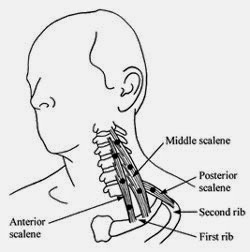
It seems that these particular muscles in the neck is the solution to many problems in the upper body.  It’s called scalenes (SKAY-leenz) and located in each side of the neck, next to the vertebrae.  I never forget to work on these hidden muscles in the neck. 
Many people avoid touching the neck or don’t want it touched.  However, working on these muscles solves so many pain problems in the upper body.
© Clair Davies
  • Upper back pain (the inner edge of the shoulder blade)
  • Mid back pain
  • Chest pain
  • Front, side and back of shoulder pain
  • Front and back of arm pain/numbness
  • Pain, numbness, tingling, swelling in the arm and hand; symptoms of thoracic outlet syndrome 
Scalenes consist of three muscles (anterior, middle, and posterior), and attach to the sides of neck vertebrae and to the first and the second ribs. 

© Clair Davies
They help support the weight of the head, and flex and turn the neck, but the main job is to lift the ribs when you inhale, so it has to do with breathing.  Breathing shallowly with the chest because of emotional tension or respiratory problems stress the scalenes.  However, daily activities like working with arms out in front of the body, pulling, lifting, and carrying a heavy back pack, and sports activities also easily overtax the muscles.

If you have one (or more) problems above, let’s focus on your neck first.  In the next post, I will show you how to massage the scalenes.